Starting a business
How to Start a Wheelchair Transportation Business in 2027: Vans, ADA Rules, and Rates
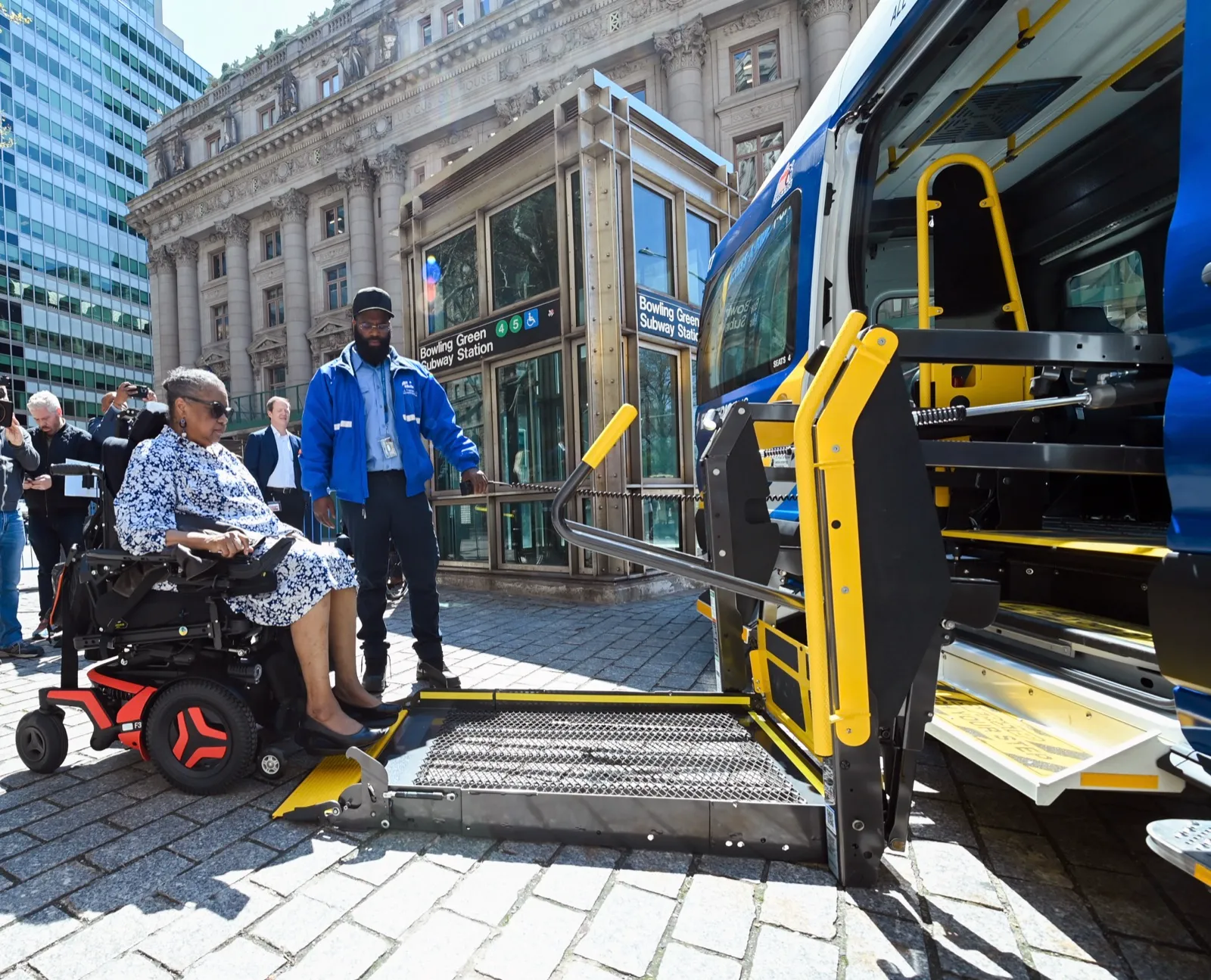
.jpg)
To start a wheelchair transportation business, form your company and get an EIN and an NPI. Check whether your state licenses wheelchair vans, as Ohio and New Jersey do. Buy a van that meets the ADA specs in 49 CFR part 38 and train drivers on lifts and securement. Then enroll with Medicaid and brokers, which pay the wheelchair rate only for riders who need it.
- Medicaid pays the wheelchair rate only when the rider needs a wheelchair van, and many programs want a signed certification or a prior approval for each rider.
- Medicaid wheelchair base rates vary widely: $11.15 a trip in urban Arizona (October 1, 2026), $31.00 in Ohio, and $52.90 for a New York City ambulette, plus a rate per mile.
- Ohio, New Jersey, New York, and Minnesota add a license, permit, or certificate for wheelchair vans, and each can inspect the vans.
- Federal ADA rules apply on every trip: use the securement system, help with the lift, never force a transfer, and keep lifts and straps working.
- Buy the van your state and brokers will approve. GSA paid $68,750 to $74,495 for full-size lift vans in May 2026.
A wheelchair transportation business is a NEMT company built around wheelchair vans. It follows the same startup path as any NEMT business, with five differences. The van costs more. Some states license it separately. Federal ADA rules govern every lift and every strap. Drivers do hands-on work. And payers pay a higher rate, but only for riders who truly need a wheelchair van.
How to start a wheelchair transportation business: the steps
- Find out who pays for wheelchair rides in your area: the state, a broker, health plans, facilities, or riders.
- Learn which trips pay a wheelchair rate and what paperwork proves the rider needs one.
- Form the company and get your EIN and NPI.
- Get any wheelchair van license your state requires, before the first ride.
- Buy a van that meets the ADA specs and your state’s and brokers’ rules.
- Insure the company and every van to the highest limit your state or brokers set.
- Hire and train drivers on lifts, securement, and passenger assistance.
- Set up the ADA rules your drivers follow on every trip.
- Enroll with Medicaid and get credentialed with each broker and plan.
- Fill the van with dialysis, discharge, facility, and private pay rides.
Step 1: Find out who pays for wheelchair rides where you live
Medicaid must get its members who use wheelchairs to care in a vehicle that fits them. CMS says in its Medicaid Transportation Coverage Guide (SMD 23-006, September 28, 2023) that if a member uses a wheelchair, the state must ensure the provider carries them in a wheelchair-accessible vehicle. That rule creates steady demand for wheelchair vans.
Who sends and pays for those trips depends on your state. See how states run NEMT and the brokers in each state.
| Who pays | How you get the trips | Example |
|---|---|---|
| State Medicaid, fee-for-service | Enroll with the state and bill it directly | Ohio pays enrolled wheelchair van providers directly (OAC 5160-15-21) |
| A broker hired by the state or a plan | Pass the broker’s credentialing and sign its agreement | Virginia fee-for-service rides run through MTM Health |
| A Medicaid health plan | Contract with the plan or its broker | Ohio lets plans set rates in their provider agreements (OAC 5160-15-28) |
| Hospitals, nursing homes, dialysis centers | A facility contract, with the facility paying per trip | Discharges and facility-to-facility transfers |
| Riders and families | Private pay at your own price | Riders without Medicaid, or trips Medicaid does not cover |
Even where the state pays directly, someone may have to approve each wheelchair trip first. In North Dakota, the human services zone or tribal office approves wheelchair van trips on form SFN 1507, and hospitals authorize discharge rides on form SFN 249 (manual updated January 2026). In New York, the prior authorization official decides whether an ambulette is medically necessary.
Step 2: Learn which trips pay a wheelchair rate
The payer decides the level of service from the rider’s needs, not from your vehicle. A rider who walks with a cane is an ambulatory rider, even inside your wheelchair van.
| Program | Who qualifies for a wheelchair van | What proves it |
|---|---|---|
| Arizona fee-for-service (manual revised July 31, 2026) | The member must require transportation by wheelchair and be physically unable to use other modes | The Daily Trip Report, which names the vehicle type |
| Ohio Medicaid (OAC 5160-15-22 and 5160-15-27) | The rider needs a mobility device from pickup to drop-off and rides in it between the van and the appointment. A cane, crutch, or walker alone does not qualify. | Form ODM 03452, Certification of Necessity for Transportation by Wheelchair Van, signed before you bill a fee-for-service trip |
| North Dakota (manual updated January 2026) | A mobility impairment severe enough that the member cannot safely use a bus, taxi, private car, or other common carrier | Form SFN 1507 from the human services zone or tribal office, or form SFN 249 from the hospital for a discharge |
| Virginia through MTM Health (handbook approved August 10, 2026) | Members who use wheelchairs or other mobility devices but can sit upright | The trip manifest, which lists the authorized mode and level of assistance |
| New York (policy manual effective August 25, 2023) | The prior authorization official finds an ambulette medically necessary | The prior authorization, backed by a written order from the rider’s practitioner and the state’s form on the rider’s transportation abilities |
Ohio’s certification rules show how strict this gets (OAC 5160-15-21 and 5160-15-27). A physician, podiatrist, advanced practice registered nurse, physician assistant, licensed nurse, physical or occupational therapist, chiropractor, psychologist, or certified rehabilitation counselor may sign the ODM 03452. Ohio Medicaid plans may use their own process instead. Nobody who works for or with your company may sign it. It lasts up to 90 days for a temporary need, or one year for an ongoing one. Falsely certifying that a rider needs a mobility device is Medicaid fraud.
Carrying walking riders is allowed, but you bill them at their own level. New York says an ambulette may give curb-to-curb taxi rides and bills those rides with taxi codes.
The codes on a wheelchair claim
| Code | What it covers | How it is billed |
|---|---|---|
| A0130 | Non-emergency transportation, wheelchair van | Once for each one-way trip |
| S0209 | Wheelchair van mileage, per mile | For each loaded mile, with the rider on board |
| T2001 | Patient attendant or escort | Only where your program pays it. Ohio pays $15.00 when an attendant is needed and documented. |
Your state’s fee schedule decides which codes and modifiers it pays. The full code list is in the NEMT billing codes guide.
What Medicaid pays for a wheelchair trip
These are fee-for-service rates for one trip leg. Brokers and health plans pay by contract, but the state schedule shows what a wheelchair trip is worth.
| Program | Base rate (A0130) | Per mile | Effective |
|---|---|---|---|
| Arizona, Phoenix and Tucson areas | $11.15 | $1.54 | October 1, 2026 |
| Arizona, rest of state (TN modifier) | $12.21 | $1.66 | October 1, 2026 |
| Louisiana | $21.50 | $1.30 | January 1, 2022, on the schedule effective October 1, 2025 |
| Louisiana, higher level of care | $31.50 | $1.30 | October 1, 2025 |
| North Dakota | $18.05 | $2.57 | July 1, 2026 |
| Ohio | $31.00 | $1.30 | January 1, 2024, on the rule effective August 1, 2026 |
| New York City ambulette | $52.90 | $3.60 | May 30, 2024 for the base, April 1, 2022 for mileage |
Arizona, North Dakota, Ohio, and New York bill mileage with S0209 and pay only for miles with the rider on board. Louisiana’s schedule lists one mileage rate for both wheelchair rates, paid per mile beginning at mile zero. Ohio says the drive to the pickup is part of the service, is not paid separately, and cannot be billed to the rider (OAC 5160-15-26). Ohio also caps mileage at 50 miles from the pickup unless you keep records that justify the longer trip.
Louisiana added a second wheelchair rate for a higher level of care on October 1, 2025. Ask the plan or broker which riders qualify for it. Louisiana brokers must pay you at least the fee-for-service rate in effect on the date of service, unless your provider agreement sets a different rate (Medicaid Services Manual, section 10.1, issued July 14, 2025).
Pay for one trip leg = base rate + (loaded miles × mileage rate)
Here is what a 10-mile one-way trip pays, next to an ambulatory trip on the same schedule where the state lists one:
| Program | Wheelchair trip, 10 loaded miles | Ambulatory trip, 10 loaded miles | Difference |
|---|---|---|---|
| Arizona, Phoenix and Tucson (A0120 base plus S0215 mileage for ambulatory) | $26.55 | $19.44 | $7.11 |
| Louisiana (T2003 for ambulatory) | $34.50 | $24.50 | $10.00 |
| Louisiana, higher level of care | $44.50 | $24.50 | $20.00 |
The same 10-mile wheelchair trip pays $43.75 in North Dakota and $44.00 in Ohio.
The higher rate has to pay for a van that costs more and for the minutes each lift and securement takes. Run your own costs through the trip price calculator before you accept a contract rate. For every state’s rates, see NEMT reimbursement rates.
Step 3: Form the company and get your numbers
Form an LLC or corporation in your state first, because every later approval uses its legal name. See LLC for NEMT.
- EIN. Get it directly from the IRS online, for free. The IRS issues it right away when the application is approved.
- NPI. Apply in NPPES for an organization (Type 2) NPI and pick the taxonomy code that fits your service. Code 343900000X is Non-emergency Medical Transport (VAN). The NUCC code set, version 26.1 (July 1, 2026), describes it as a vehicle able to meet special height, clearance, access, and seating needs. See how to get an NPI number for NEMT.
- Medicaid application fee. CMS set the fee at $750 for enrollment applications filed from January 1 to December 31, 2026, in states that collect it.
Step 4: Get a wheelchair van license if your state requires one
Some states license wheelchair vans on their own, apart from Medicaid. In those states, get the license and each vehicle’s permit or decal before the first wheelchair ride. Some call the vehicle an ambulette.
| State | What a wheelchair company needs | Fees and timing | Rule |
|---|---|---|---|
| Ohio | An ambulette service license and a permit for each ambulette, with a decal on the rear window. The board inspects each van before its first permit and every year after. | The board rules on a complete license application within 60 days and a permit within 45 days. Both last one year. | Ohio Rev. Code 4766.04 and 4766.07 |
| New Jersey | A mobility assistance vehicle (MAV) license for the company and each vehicle | A new provider pays $1,500 plus $100 per vehicle, or $1,250 plus $50 per vehicle in the second year of the two-year license cycle. Running without a license can cost $1,000 a day, plus $1,000 a day per unlicensed vehicle. | N.J.A.C. 8:40, readopted September 25, 2023, expires September 25, 2030 |
| New York | A NYS Department of Transportation common carrier certificate or contract carrier permit, and a DMV letter of compliance with Article 19-A dated on or after the most recent July 1. The state DOT inspects ambulettes twice a year. | Both documents go in with the Medicaid enrollment | eMedNY enrollment requirements (October 2025) |
| Minnesota | A special transportation service certificate of compliance from the Department of Transportation for service paid with public money, with vehicles inspected at least once a year | A $45 decal for each vehicle, every year | Minn. Stat. 174.30 |
Ohio’s license law lists the places it covers: wheelchair rides between hospitals, emergency departments, dialysis centers, nursing homes and other long-term care, surgical facilities, inpatient rehabilitation, memory care centers, practitioners’ offices, and other licensed inpatient facilities. For Medicaid, a wheelchair van must meet Ohio’s ambulette licensing standards (OAC 5160-15-01), and every vehicle must meet the permit rules (OAC 5160-15-21).
Other states have no separate wheelchair license and rely on Medicaid enrollment, broker credentialing, and local permits. Check your state guide and the NEMT license requirements. Where your state calls these vans ambulettes, see how to start an ambulette business.
Step 5: Buy a van that meets the ADA specs
Under federal ADA rules, a van counts as accessible only if it meets the specs in 49 CFR part 38 (49 CFR 37.7). Brokers check for them: MTM Health’s Virginia handbook (approved August 10, 2026) requires part 38 and says MTM will inspect for it.
| Federal spec (49 CFR 38.23, September 2026) | What it requires |
|---|---|
| Wheelchair positions | At least 1 on a van 22 feet or shorter, at least 2 on a longer van |
| Lift | A design load of at least 600 pounds, an interlock so the van cannot move with the lift out, and a backup way to lower the rider if power fails |
| Ramp | 600 pounds if 30 inches or longer, 300 pounds if shorter, 30 inches wide, no steeper than 1:4 to the ground |
| Space at each position | A clear floor area of 30 by 48 inches, as close to the door as practicable |
| Securement | 2,500 pounds per tie-down and 5,000 pounds per chair on vans rated under 30,000 pounds, holding the chair to 2 inches of movement |
| Rider belt | A lap belt and shoulder harness at every position, never used in place of the chair securement |
States and brokers add their own specs. Virginia (updated May 26, 2026) wants four working securements at each position, a working interlock, and a lap and shoulder belt mounted to the van. Its broker records each lift’s maker, model, age, and rated capacity, to match riders to lifts. A van that takes hospital discharges must carry a spare wheelchair with a seat at least 20 inches wide. New Jersey requires a four-point, forward-facing restraint that holds each chair to one inch of movement, and a ramp or lift rated for at least 500 pounds (N.J.A.C. 8:40-5.6 and 5.7).
Watch the lift question before you buy. Arizona’s fee-for-service manual says wheelchair vans shall include lifts. North Dakota defines a wheelchair van as any van with a wheelchair lift. Ask each payer, in writing, whether a ramp minivan qualifies. The trade-offs are in wheelchair ramp vs lift and how to choose a wheelchair van.
For a price check, GSA, which buys vehicles for federal agencies, paid $68,750 on May 14, 2026 and $74,495 on May 29, 2026 for full-size vans with two wheelchair positions and a rear lift. A rear-ramp version cost $74,000 on June 26, 2026. See wheelchair van cost and used wheelchair vans.
Step 6: Insure the company and every van
Insurance limits come from your state license, your state Medicaid program, and each broker. Buy to the highest one.
| Program | Minimum insurance |
|---|---|
| Ohio ambulette license (Ohio Rev. Code 4766.06) | $500,000 per occurrence and $500,000 in aggregate of liability coverage. Each vehicle also carries $100,000 per person and $300,000 per accident for bodily injury, plus $50,000 for property damage. The insurer must give the board 30 days’ notice of cancellation. |
| New Jersey MAV license (N.J.A.C. 8:40) | $500,000 per occurrence of combined bodily injury and property damage for each vehicle, plus $300,000 of general liability. MAV service must stop at once if any required coverage lapses. |
| MTM Health standard agreement (Pennsylvania, January 1, 2023) | $500,000 per occurrence and in aggregate for general liability, a $500,000 combined single limit for auto, and workers’ compensation at your state’s amounts. Coverage must include loading and unloading. |
| Virginia fee-for-service (DMAS, May 26, 2026) | Wheelchair vans carry the amount the Virginia DMV requires |
Wheelchair work adds risk while a rider is on the lift or ramp. MTM’s agreement asks for broad form coverage that includes loading and unloading, so ask your agent to confirm in writing that your policy covers it. See NEMT insurance requirements.
Step 7: Hire and train drivers for wheelchair work
Federal ADA rules require training to proficiency. Under 49 CFR 37.173, your staff must be trained to run the vehicles and equipment safely and to assist riders with disabilities respectfully and courteously. States and brokers spell out what that means.
| Program | What wheelchair drivers need |
|---|---|
| Minnesota special transportation (Rules 8840.5910 and Minn. Stat. 174.30) | Before any work: a cleared state background study. Before the first ride: instruction and a demonstration on the ramp, lift, and securement, plus a behind-the-wheel evaluation. Within 45 days: 4 hours of first aid, 4 hours of classroom defensive driving, abuse prevention training, and 8 hours of passenger assistance training for anyone who carries riders seated in wheelchairs. |
| Louisiana (manual issued July 14, 2025) | PASS and wheelchair securement, renewed at least every two years. Drivers at companies with wheelchair vans take securement training in person. In-person CPR, a defensive driving course of at least 4 hours every three years, and HIPAA. |
| New Jersey MAV (N.J.A.C. 8:40-5.3) | A CPR card and a PAT or MAV Technician card, or EMT-Basic and CPR if the van carries oxygen equipment. A second trained crew member when a wheelchair rider is moved up or down five or more steps, or weighs 200 pounds or more and is moved up or down two or more steps. |
| Virginia through MTM Health (August 10, 2026) | At least 21 years old with two years of driving experience, and no more than two chargeable accidents or moving violations in three years. PASS, HIPAA, defensive driving, and first aid and wheelchair securement where they apply, all before the first ride. |
Federal Medicaid rules add a floor for every driver. CMS lists them in SMD 23-006: the driver is not excluded from federal health programs and holds a valid license. Your company must also have processes to handle state drug law violations and to report each driver’s driving history to the state Medicaid program.
Train on your own vans. Each lift, ramp, and tie-down kit works a little differently, and Minnesota requires a demonstration of the ramp, lift, and securement devices before the first ride. See NEMT driver training, PASS certification, and wheelchair securement step by step.
Step 8: Set up the ADA rules for every trip
The federal DOT rules below apply to private companies as well as public ones. Put them in your policies and your driver training.
- Use the securement system. On a van built to part 38, secure every wheelchair with it. You may require the rider to let you secure the chair (49 CFR 37.165).
- Do not refuse a chair that will not secure well. You may not deny a ride because the chair cannot be secured to your satisfaction.
- Carry heavier riders when you can. You must carry a chair and rider heavier than the design standard if your lift and van can hold them. You may decline only when the weight is over the lift’s rating, or carrying them is shown to be unsafe. See bariatric transportation.
- Never force a transfer. You may suggest the rider move to a seat, but you may not require it.
- Help with the lift and straps. Drivers must help with securement, ramps, and lifts when needed or asked, and leave their seat to do it.
- Let standing riders use the lift. Riders with walkers, canes, or braces may ride the lift up.
- Keep lifts and securement working. Repair them promptly, and take reasonable steps to serve riders while a lift is out (49 CFR 37.161). Minnesota requires a daily inspection of each vehicle and its equipment, and a record of lift tests.
- Do not require an attendant, and do not turn riders away because of your insurance company’s conditions (49 CFR 37.5).
- Do not add special charges on riders with disabilities for services these rules require (49 CFR 37.5(d)).
States can ask for more. New York requires ambulette staff to give door-to-door help at no extra charge, from the rider’s front door, apartment door, or nursing home room to the practitioner’s door (policy manual effective August 25, 2023).
Log each lift check with the wheelchair lift inspection checklist, and see ADA requirements for NEMT for the full rule set.
Step 9: Enroll with Medicaid and get broker contracts
Apply to whoever pays for rides in your state. Where the state pays directly, you enroll with the state Medicaid agency, pass federal screening, and pay the $750 fee for 2026 if your state charges it. Ohio wheelchair van providers bill the state directly or through their contracts with Medicaid plans. See how to become a Medicaid transportation provider.
Where a broker runs rides, you credential with the broker. In Virginia, for example, the broker must credential every driver and inspect every vehicle before they carry members. Brokers also set service standards that shape a wheelchair company’s day. MTM Health’s Virginia handbook (May 2026) gives these:
- Trip offers. Dispatchers call providers four to five days before the appointment to confirm trips.
- Will-call returns. The van must arrive within 45 minutes of the rider’s call.
- Hospital discharges. The van must arrive within three hours of notice, or MTM charges liquidated damages.
- Level of assistance. Each manifest says curb-to-curb, door-to-door, or hand-to-hand, and your driver must give that level. It also lists the rider’s weight with the mobility device, so you can match the rider to a lift that holds them.
See NEMT broker credentialing, how to get NEMT broker contracts, and the broker directory.
Step 10: Fill the van with steady work
A wheelchair van earns the most when its days are full of repeat and scheduled trips.
- Dialysis. Treatments repeat on a fixed weekly schedule, so one standing order fills the same slots week after week. See dialysis transportation.
- Hospital discharges. These trips come on short notice, such as MTM’s three-hour window in Virginia. Carry the spare wheelchair Virginia’s rules call for, and see hospital discharge transportation.
- Nursing homes and other facilities. Residents need rides to specialists and between facilities. A facility contract can cover riders who have no Medicaid ride benefit. See NEMT facility contracts.
- Private pay. Families pay for rides Medicaid does not cover. Federal rules bar special charges on riders with disabilities for services the ADA requires (49 CFR 37.5(d)), so have an attorney review your private pay price list. North Dakota also bars charging Medicaid more than you charge riders who pay privately. See private pay NEMT.
Mistakes that cost new wheelchair companies money
- Buying the wrong van. A ramp minivan may not qualify where a program expects a lift. Get each payer’s vehicle rules in writing first.
- Billing a wheelchair rate for a rider who walked. Ohio pays no wheelchair rate on a trip with no mobility device, even during a valid certification.
- Letting certifications lapse. Ohio’s ODM 03452 lasts up to 90 days or one year. Track the end dates.
- Running before the license. Ohio needs a permit for each van, and New Jersey can fine you $1,000 a day for running without a license.
- Billing the empty miles. Arizona, North Dakota, Ohio, and New York pay only for miles with the rider on board. The drive to the pickup is on you.
- Sending one driver to a heavy chair on steps. New Jersey requires a second crew member for five or more steps, or two or more steps with a rider of 200 pounds or more.
- Skipping the daily lift check. A broken lift means refused trips and, under 49 CFR 37.161, a duty to fix it promptly.
- Guessing at insurance. Buy to your state’s and your broker’s highest limits, with loading and unloading covered.
Frequently asked questions
How much does it cost to start a wheelchair transportation business?
The van is the big cost. GSA, the federal government's vehicle buyer, paid $68,750 to $74,495 for full-size vans with two wheelchair positions and a rear lift in May 2026. Fees are smaller: the EIN is free, the federal Medicaid application fee is $750 for 2026 where your state collects it, and a new New Jersey wheelchair van license costs $1,500 plus $100 per vehicle. Add insurance, training, and cash to cover payroll until claims pay.
Do I need a special license to run wheelchair vans?
In some states. Ohio requires an ambulette service license and a permit for each van for wheelchair rides between hospitals, dialysis centers, nursing homes, doctors' offices, and similar sites, and Ohio Medicaid pays only for vans that meet those standards. New Jersey requires a mobility assistance vehicle license for the company and each vehicle. New York ambulettes need state DOT operating authority and a DMV Article 19-A letter. Minnesota requires a special transportation service certificate and a $45 decal for each vehicle each year.
How much does Medicaid pay for a wheelchair van trip?
It depends on the state. Most fee schedules pay a base rate for each one-way trip, billed with A0130, plus a rate per mile, often billed with S0209. Arizona pays $11.15 plus $1.54 a mile in the Phoenix and Tucson areas from October 1, 2026. Ohio pays $31.00 plus $1.30 a mile (rule effective August 1, 2026), North Dakota $18.05 plus $2.57 (July 1, 2026), and Louisiana $21.50 plus $1.30 (schedule effective October 1, 2025). Brokers and health plans set their own rates by contract.
Can I use a ramp minivan instead of a lift van?
Federal ADA rules allow either, as long as the ramp or lift meets 49 CFR 38.23. Some programs lean toward lifts. Arizona's fee-for-service manual says wheelchair vans shall include lifts, and North Dakota defines a wheelchair van as any van with a wheelchair lift. Ask your state Medicaid agency and each broker, in writing, whether a ramp van qualifies before you buy one.
Can my wheelchair van carry riders who walk?
Yes, but you are paid for the rider's level of service, not your van. New York says an ambulette may give curb-to-curb taxi rides but bills them with taxi codes. Ohio pays no wheelchair van rate during a rider's certification period for any trip where no mobility device is involved. Your trip manifest or authorization shows the level you may bill.
Can I refuse a rider whose wheelchair is too heavy or will not secure?
Only in narrow cases. Under 49 CFR 37.165 you must carry a chair and rider heavier than the ADA design standard if your lift and van can hold them. You may decline when the combined weight is over the lift's rating or carrying them is shown to be unsafe. You may not refuse a rider because the chair cannot be secured to your satisfaction, and you may not require the rider to transfer to a seat.
Official resources
- eCFR: 49 CFR part 38 (ADA specs for wheelchair vans)
- eCFR: 49 CFR 37.165 (lift and securement use on every trip)
- IRS: Get an employer identification number
- Ohio Revised Code 4766.04 (ambulette service license)
- Ohio Administrative Code 5160-15-27 (wheelchair van certification of necessity)
- New Jersey N.J.A.C. 8:40 (mobility assistance vehicle rules)
- eMedNY: Transportation enrollment requirements by category
- Minnesota Rules 8840.5910 (driver and attendant training)