Drivers and vehicles
How to Choose a Wheelchair Van for NEMT in 2027: Entry Side, Ramp or Lift, and Specs
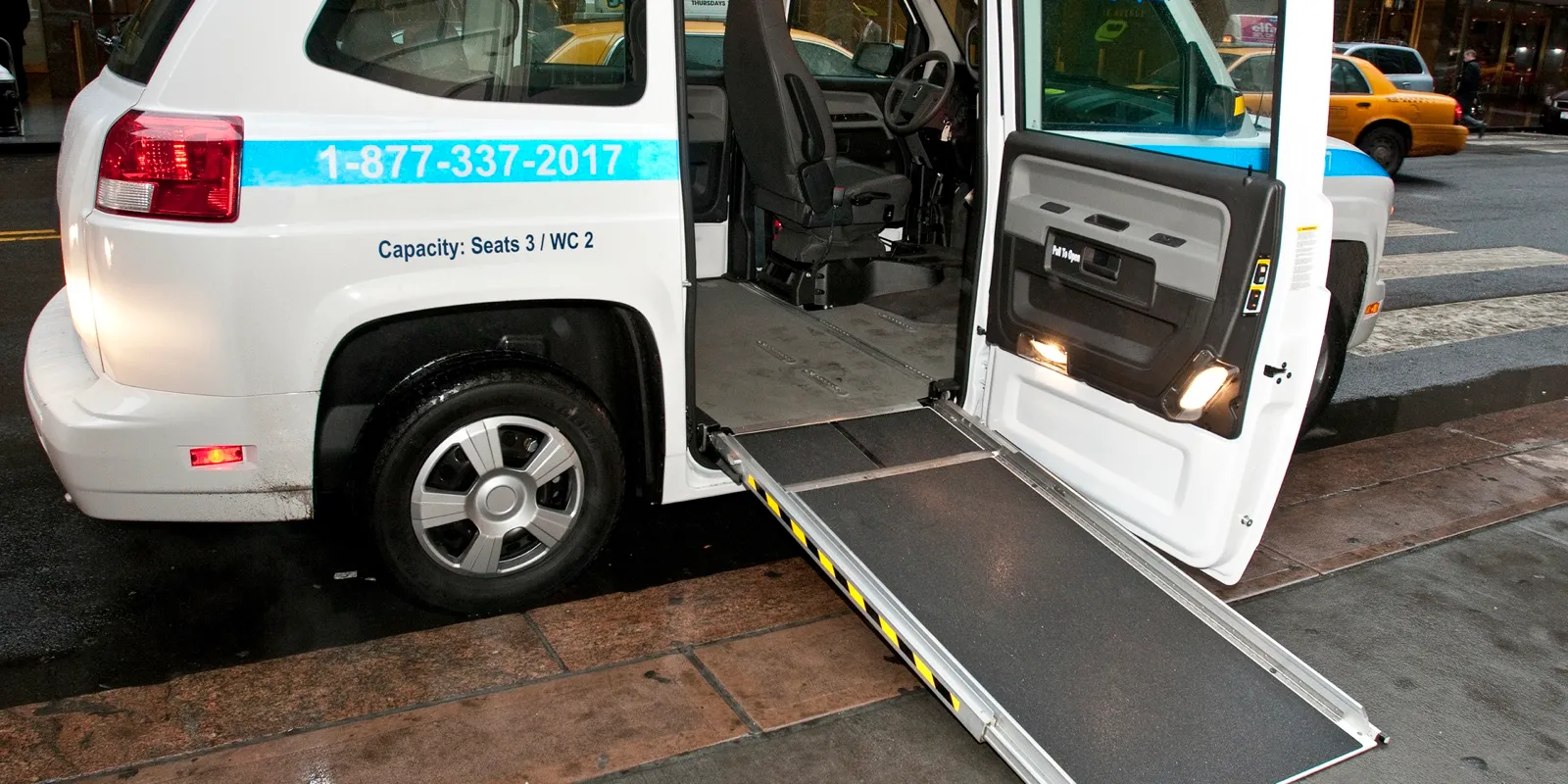
.jpg)
The right wheelchair van for NEMT is one your brokers will approve for your trips. It must meet the federal ADA specs in 49 CFR part 38, such as a lift built for 600 pounds and a 56-inch door on vans 22 feet or shorter. Then pick side or rear entry, ramp or lift, and the number of wheelchair positions your riders and rules call for.
- Every NEMT wheelchair van must meet 49 CFR part 38: a 600-pound lift or ramp (300 pounds for ramps under 30 inches), and 56 inches of door and interior height on vans 22 feet or shorter.
- Side entry lets the rider board from the sidewalk. Rear entry loads behind the van, and Wisconsin bars rear-door loading on any public road.
- A lift raises the chair on a level platform and carries standing riders. A ramp to the ground can be as steep as 1:4, so drivers may have to push manual chairs up it.
- State and broker specs go further. New Jersey wants 58 inches of height, Wisconsin a 700-pound lift, and Virginia four tie-downs and a vehicle-mounted belt per station.
- Before you pay, check the converter label, the lift's DOT label and rated load, and any roof certificate your state asks for.
A wheelchair van is a large purchase for a small NEMT company, and its layout decides which trips it can take for years. Choose in this order: the rules the van must pass, which door the chair uses, ramp or lift, minivan or full-size, how many wheelchair positions, and how much weight it can carry. Then check every broker’s specs and the paperwork before you pay.
What every NEMT wheelchair van must meet
Start with the federal floor. A vehicle counts as accessible under the ADA only if it meets the specifications in 49 CFR part 38 (49 CFR 37.7). Brokers hold you to it: Virginia’s NEMT rules (updated May 26, 2026) require part 38 before a van is approved, and MTM Health’s standard provider agreement (January 1, 2023) requires vehicles that carry members with mobility devices to meet the federal ADA vehicle rules.
The ADA also shapes what you buy. A private company in the business of carrying people that buys or leases a new vehicle other than a car for demand response rides must get an accessible one, unless its service as a whole already gives wheelchair users equal service (49 CFR 37.103). That includes vans that seat fewer than 8 people, counting the driver.
| Federal spec | Van 22 feet long or less | Van longer than 22 feet |
|---|---|---|
| Wheelchair stations | At least 1 | At least 2 |
| Door opening, measured from the raised lift or top of the ramp | 56 inches high | 68 inches high |
| Interior height from the lift to the station | 56 inches | 68 inches |
| Station direction | Forward, or rear-facing with a padded barrier | At least one forward-facing |
| Lift | Designed for at least 600 pounds, with an interlock and a backup for power failure | Same |
| Ramp | 600 pounds if 30 inches or longer, 300 pounds if shorter, 30 inches wide | Same |
| Securement | 2,500 pounds per leg and 5,000 pounds per chair on vans rated under 30,000 pounds | Same |
| Rider belt | A lap and shoulder belt at each station | Same |
These come from 49 CFR 38.23, 38.25, and 38.29, as in force in September 2026. The full list, including lighting, contrast bands, and signs, is in the NEMT vehicle requirements guide. For what makes a vehicle a WAV in plain terms, see what is a WAV.
The lift has its own safety standards
Two federal motor vehicle safety standards cover platform lifts. Lifts built on or after April 1, 2005 must meet FMVSS 403, and vehicles built on or after July 1, 2005 with a lift must meet FMVSS 404. A van rated over 10,000 pounds must have a lift certified as a public use lift. A lighter van may carry either a public use or a private use lift.
The test loads differ. A public use lift is tested at 600 pounds, the same design load the ADA sets. A private use lift is tested at its maker’s rated load or 400 pounds, whichever is greater. Each lift carries a label that reads “DOT-Public Use Lift” or “DOT-Private Use Lift”, so check it before you buy. The operating steps, including backup steps, must be posted next to the lift controls (FMVSS 404).
A newer federal guideline to plan for
In December 2016 the U.S. Access Board updated its accessibility guidelines for buses and vans. The update would require lifts certified as public use lifts and ramps no steeper than 1:6 to the roadway or a curb. In vehicles 25 feet or shorter, it would also require wheelchair riders to face forward. As of September 2026, the Access Board says these updates are not yet part of DOT’s enforceable standards. To buy ahead of that change, ask for forward-facing positions, a public use lift, and a ramp no steeper than 1:6.
Side entry or rear entry
Side-entry vans load the wheelchair through a door on the passenger side. Rear-entry vans load it through the back. Both can meet 49 CFR part 38, so the choice turns on where your riders board and what your state allows.
| Question | Side entry | Rear entry |
|---|---|---|
| Where the rider boards | Beside the van, onto the sidewalk or curb when you park next to one | Behind the van, in a lot, a driveway, or the street |
| Space needed | Room beside the van for the ramp or lift and for the chair to turn | Room behind the van, so parking in tight spaces matters |
| Ramp slope | Deployed to a 6-inch curb, the limit depends on how high the floor sits above the curb | Deployed to the ground, a ramp may be as steep as 1:4 |
| State rules that affect it | New Jersey mobility assistance vehicles need a curb-side doorway in the front half of the body | Wisconsin bars rear-door loading and unloading on any public road |
The curb rule for ramps is in 49 CFR 38.23. When the van floor sits 3 inches or less above a 6-inch curb, the ramp may be 1:4. From 3 to 6 inches above, the limit is 1:6. From 6 to 9 inches, it is 1:8, and above 9 inches the ramp must reach 1:12.
Three state rules show how much the door matters:
- Wisconsin. Human service vehicles that carry wheelchair riders follow Trans 301. A side ramp or lift must be fully contained and fastened inside the vehicle body when not in use. A van that loads through its rear door may not load or unload riders on a highway, and state law defines highway to include every public street (Trans 301.60 and Wis. Stat. 340.01(22)).
- New Jersey. A mobility assistance vehicle’s patient compartment needs two exterior doorways that are not next to each other: one on the curb side in the front half of the body, and one at the rear or on the driver’s side. Each doorway is at least 28 inches wide, one is at least 56 inches high, and the ramp or lift may not block both (N.J.A.C. 8:40-5.7 and 5.8).
- Minnesota. A vehicle with a wheelchair lift must have a front entrance door in addition to the lift door (Minnesota Rules 8840.5940).
If most of your pickups are at city curbs, a side-entry van keeps the rider out of the street. If you work mostly at facility entrances, parking lots, and driveways, rear entry can work, as long as your state allows it. Ask your broker whether it limits either type before you commit.
Ramp or lift
A ramp is a folding or sliding surface the rider rolls up. A lift is a platform that raises the rider to the floor. The federal rules for each are in 49 CFR 38.23, and the detailed comparison is in wheelchair ramp vs lift.
| Ramp | Lift | |
|---|---|---|
| Strength | 600 pounds if 30 inches or longer, 300 pounds if shorter | Designed for 600 pounds, with working parts built to six times that load |
| Slope | No steeper than 1:4 to the ground. To a curb, from 1:4 to 1:12 depending on floor height | A level platform; its entrance edge no steeper than 1:8 for a rise of up to 3 inches |
| Power failure | Powered ramps in New Jersey need manual operation or a backup | A backup way to lower an occupied lift and stow an empty one |
| Standing riders | Must be open to riders who walk with canes or walkers (49 CFR 37.165) | Must carry riders with canes, walkers, or braces (49 CFR 38.23) |
| Driver effort | DOT guidance says drivers may have to push a manual chair up a steep ramp | The platform raises the chair |
| Federal standard | The ADA ramp rules in 49 CFR 38.23 | The ADA lift rules plus FMVSS 403 and 404, with a DOT label |
States add their own lift and ramp rules:
- Georgia (July 1, 2026). Full-size wheelchair vans must have a hydraulic or electro-mechanical lift. Lowered-floor minivans with a fold-out ramp must meet ADA rules. The interlock must require park and the emergency brake while the lift or ramp is out.
- Wisconsin (Trans 301.62 and 301.63). A power lift needs a minimum capacity of 700 pounds, and a stowed ramp must lock in place so it cannot move while driving.
- New Jersey (N.J.A.C. 8:40-5.7). An operable ramp or fully automatic lift rated for at least 500 pounds, permanently fastened to the vehicle. A powered ramp or lift needs a manual backup that raises or lowers the rider within five minutes.
- Minnesota (Rules 8840.5925). A lift used by riders who can stand must have a railing 28 to 36 inches high on one side, or the van must carry a folding wheelchair for them.
Minivan or full-size van
The two common builds are a lowered-floor minivan with a ramp and a full-size van with a lift, and Georgia’s manual names both. Height and space are where they differ most on paper, so measure before you buy.
| Rule | What it asks for |
|---|---|
| Federal, vans 22 feet or shorter | 56 inches of door clearance over the raised lift or ramp, and 56 inches of interior height from the lift to the station |
| Georgia (July 1, 2026) | At least 56 inches from floor to ceiling in the passenger compartment |
| New Jersey mobility assistance vehicles | At least 58 inches from floor to ceiling above each wheelchair position, 56 inches wide at 42 inches above the floor, and 82 inches long for one or two wheelchair positions or 92 inches for three or four |
| Minnesota | Vans must meet the federal roof crush or rollover standard, FMVSS 216 or 220, with a certificate from the maker or the company that rebuilt the roof |
The Minnesota rule matters most for raised-roof conversions. When a roof has been altered, the certificate must name the vehicle’s VIN, the company that altered the roof, and the lab that tested the design to FMVSS 220. Federal rules let a repair shop that raises a roof for riders with disabilities skip the newer roof crush standard, FMVSS 216a, only if the van then meets FMVSS 220 (49 CFR 595.7).
For the day-to-day differences, see minivan vs full size wheelchair van, lowered floor vans, and wheelchair van conversion.
Seating layouts and how many wheelchair positions
Each wheelchair position needs a clear floor area of 30 by 48 inches, as close to the accessible door as practicable, with its own securement and rider belt (49 CFR 38.23). Up to 6 inches of that space may sit under another seat for footrests, and fold-down seats may share the space if they leave it clear when folded up.
Plan the order riders get on and off. The Access Board strongly recommends against layouts where the first rider on must be the last rider off, because such layouts put severe limits on how you can run trips. It also notes that two wheelchair spaces cannot overlap.
| Layout choice | What the rules say | What to think about |
|---|---|---|
| One wheelchair position plus seats | Meets the federal minimum on a van 22 feet or shorter | Carries one wheelchair rider with escorts or walking riders |
| Two or more wheelchair positions | Each needs its own 30 by 48 inch space, securement, and belt | Lets you pair two wheelchair riders going to the same place, where your broker pays for shared rides |
| Fold-down seats in a wheelchair space | Allowed if the space stays clear when they are folded up | More flexible, but a seat must be folded before each wheelchair trip |
| A rear-facing position | Allowed on vans 22 feet or shorter with a padded barrier | The 2016 update would require forward-facing positions in vans 25 feet or shorter |
| A side-facing position | Not permitted under any circumstances, the Access Board says | Never buy a van laid out this way for wheelchairs |
Never carry more people than the maker’s seating capacity. MTM Health’s Virginia handbook (May 2026) says the total number of occupants, including the driver, may not exceed the manufacturer’s designed seating capacity. For escorts and companions, see can a caregiver ride with NEMT.
Seat count also changes your licensing. A vehicle designed to carry 16 or more passengers, including the driver, needs a CDL (49 CFR 383.5). On interstate trips, a vehicle designed or used for more than 8 passengers including the driver for pay, or rated 10,001 pounds or more, falls under the federal motor carrier safety rules (49 CFR 390.5). See GVWR meaning and the hours rules in rural NEMT.
Weight: lift capacity, payload, and heavier riders
The ADA sets a 600-pound design load for the lift, meaning a wheelchair and rider together. The rules also give you a reason to buy more capacity. Under 49 CFR 37.165, you must carry a chair and rider heavier than the design standard if your lift and vehicle can hold them. You may decline only when the combined weight is over the lift’s rating, or when carrying them is shown to be unsafe. DOT’s guidance gives the example of a lift that safely holds 800 pounds: you may limit it to 800 pounds, but you must carry anyone within that limit.
Brokers track this. Virginia’s rules (May 26, 2026) have the broker record the age, maker, model, and rated capacity of every lift in its network, so it can send riders to vans that can lift them. Wisconsin requires 700 pounds. A higher-rated lift can open trips that other vans must turn down. See bariatric transportation.
Payload matters as much as the lift. Every van has a certification label near the driver’s seat, on the door edge or a door pillar, showing its gross vehicle weight rating, or GVWR (49 CFR 567.4). To stay under it:
- Find the GVWR on the label, and on any second label from the converter.
- Weigh the finished van with its lift, securement, and fuel, at a public scale.
- Subtract the van’s weight from the GVWR. What is left is what you can carry.
- Add up a full load: the driver, each wheelchair rider in their chair, escorts, and walking riders.
- Keep the full load under what is left, with room to spare for heavy power chairs.
A van rated over 10,000 pounds must use a public use lift (FMVSS 404) and, on interstate trips, falls under the federal motor carrier safety rules (49 CFR 390.5).
Broker and state specs to check before you buy
Your brokers and your state may ask for more than the federal list. Here is what eight programs add, as of September 2026.
| Program | What it adds for wheelchair vans |
|---|---|
| Virginia (DMAS, updated May 26, 2026) | Four fully working securements per station, a working interlock, and a lap and shoulder belt mounted to the vehicle and made for wheelchair riders. Vans that take hospital discharges carry a spare wheelchair with a seat at least 20 inches wide. Inspections before the first trip and twice a year. |
| Georgia (DCH manual, July 1, 2026) | 56 inches from floor to ceiling, a park and emergency brake interlock, a powered lift in full-size vans, and floor ribbing that does not block wheelchairs moving from the lift to the stations. Inspections every 6 months. |
| New Jersey mobility assistance vehicles (N.J.A.C. 8:40) | A four-point forward-facing restraint, a ramp or automatic lift rated for 500 pounds with a 5-minute manual backup, 58 inches of height, two non-adjacent doorways, and only forward-facing wheelchair positions in vehicles first licensed after February 17, 1998. No stretchers. |
| Minnesota (Rules 8840.5925 and 8840.5940) | Lifts and ramps built to 49 CFR 38.23, a front entrance door besides the lift door, door heights per 49 CFR 38.25, and a roof crush or rollover certificate. |
| Wisconsin (Trans 301 and DHS 105.39) | A lift or ramp, a 700-pound power lift, side ramps or lifts stowed inside the body, no rear-door loading on public roads, and a vehicle list showing each van’s restraint types and whether it has a lift or ramp. |
| Louisiana (Medicaid Services Manual, issued July 14, 2025) | ADA restraints, tie-downs, lifts, and ramps. The broker checks the lift and its backups and photographs a secured wheelchair. No two-door vehicles, pickup trucks, salvage titles, or stretcher vans. |
| Rhode Island (policy effective October 31, 2024) | Vehicles added after July 31, 2024 must be no more than four model years old with 150,000 miles or less at the first inspection, and may serve until 250,000 miles |
| Portland, Oregon (City Code 16.40.750) | No NEMT vehicle more than 15 years past its manufacture date, with an age exemption process for wheelchair vans |
Get each broker’s vehicle rules in writing before you shop, then ask its credentialing team to confirm your chosen van. See NEMT broker credentialing and your state guide, such as New Jersey or Georgia.
What to ask the dealer or converter
A converted van carries paperwork that proves it still meets the federal safety standards. Ask for all of it before money changes hands.
- The converter’s label. A company that converts a van before its first retail sale must add its own label next to the maker’s, with the month and year of the work and a statement that the van still meets the standards the work affected. If the GVWR changed, the new rating goes on that label (49 CFR 567.7).
- The modifier’s label and document, if a repair shop modified the van. A repair shop that modifies a van for riders with disabilities in a way that takes it out of certain safety standards must add a label saying so, and give the owner a document listing those standards. The document must show any drop in load capacity of more than 220 pounds, and say whether a wheelchair’s weight is counted in it (49 CFR 595.7).
- The lift label and rated load. Look for the “DOT-Public Use Lift” or “DOT-Private Use Lift” label, the maker’s rated load, the owner’s manual inserts, and the operating steps posted by the controls (FMVSS 403 and 404).
- A roof crush or rollover certificate. Minnesota requires one for every van, in a form the state sets, with extra details when the roof was raised.
- The securement kit. Four tie-downs per station rated for the 49 CFR 38.23 loads, the maker’s instructions, and a lap and shoulder belt made for wheelchair riders at every station. See wheelchair securement.
- A recall check. Run the VIN through NHTSA’s recall lookup before you buy.
- Your own measurements. Door opening height, interior height at each station, the 30 by 48 inch spaces, and the ramp slope at a curb and on flat ground.
- A test with a real chair. Load a power wheelchair and a manual one, secure both, and time it.
For a used van, add a full inspection of the conversion, lift or ramp, and title history. See used wheelchair van for NEMT.
How to choose a wheelchair van, step by step
- List your trips. Note the payers, the share of wheelchair trips, where riders board (curbs, driveways, facility entrances), and the heaviest chairs you carry.
- Collect the vehicle rules from your state and every broker you drive for, in writing.
- Pick the entry side that fits your pickup spots and your state’s rules.
- Pick ramp or lift from your riders, your state’s rules, and the lift capacity you need.
- Pick minivan or full-size after measuring the height and space your state requires.
- Pick the layout: how many wheelchair positions, fold-down seats, and forward-facing stations.
- Check weight and licensing: GVWR, payload, seat count, and whether any trips cross a state line.
- Check the paperwork listed above, and have your broker confirm the van.
- Price the whole van, including conversion, insurance, and upkeep. See wheelchair van cost, lease or buy a NEMT vehicle, and the wheelchair van loan calculator.
- Train every driver on that van before its first trip, with its own lift or ramp and straps.
Frequently asked questions
Is a ramp or a lift better for a NEMT wheelchair van?
Both can meet the ADA, so your riders and your contracts decide. A lift must be built for 600 pounds and lets riders who stand with a cane or walker ride the platform. A ramp 30 inches or longer must hold 600 pounds and may be as steep as 1:4 to the ground. Georgia's NEMT manual (July 1, 2026) requires a powered lift in full-size vans and lets lowered-floor minivans use a fold-out ramp that meets ADA rules.
Can I use a rear-entry wheelchair minivan for NEMT?
It can work if it meets 49 CFR part 38 and your broker approves it, but check your state first. Wisconsin's human service vehicle rules say a van that loads through its rear door may not load or unload riders on a public road, which state law defines to include every public street (Trans 301.60). New Jersey mobility assistance vehicles need two exterior doorways that are not next to each other, one on the curb side.
How many wheelchair positions should a NEMT van have?
At least one on a van 22 feet long or less, and at least two on a longer one (49 CFR 38.23). Each needs a clear 30 by 48 inch space near the door, its own securement, and a lap and shoulder belt, and Virginia requires four working tie-downs at each. More positions let you carry two wheelchair riders at once. Fold-down seats may share the space if they leave it clear when folded up.
What lift weight capacity does a NEMT van need?
The ADA minimum is a 600-pound design load for the chair and rider together. Some programs ask for more: Wisconsin requires a power lift rated for at least 700 pounds. Under 49 CFR 37.165 you must carry a heavier chair and rider if your lift and van can hold them, and you may decline only when the weight is over the lift rating or carrying them is shown to be unsafe. Virginia's broker records each lift's rated capacity to match riders to vans.
Do I need a CDL to drive a wheelchair van?
Not for most NEMT vans. Under 49 CFR 383.5, a CDL is needed for a vehicle designed to carry 16 or more passengers including the driver, or rated 26,001 pounds or more. Separate federal safety rules reach vans used on interstate trips when they are rated 10,001 pounds or more, or designed or used for more than 8 passengers including the driver for pay (49 CFR 390.5). Your state may add its own rules.
How old can a wheelchair van be for NEMT?
No federal rule sets an age limit, so your state, city, and brokers decide. Rhode Island accepts vehicles added after July 31, 2024 only if they are no more than four model years old with no more than 150,000 miles, and allows them until 250,000 miles (policy effective October 31, 2024). Portland, Oregon bars NEMT vehicles more than 15 years past their manufacture date, with an age exemption process for wheelchair vans.
Official resources
- eCFR: 49 CFR part 38 (federal specs for accessible vans)
- eCFR: 49 CFR 571.404 (lift installation standard for vans)
- U.S. Access Board: Updated guidelines for buses and vans (2016)
- NHTSA: Check a VIN for open recalls
- Virginia DMAS: NEMT driver, attendant, and vehicle requirements
- Georgia DCH: NEMT policies and procedures (wheelchair vehicle rules in section 909)
- Wisconsin Trans 301 (human service vehicle equipment rules)