Drivers and vehicles
NEMT Driver Training in 2027: What to Teach Before the First Ride
.jpg)
NEMT driver training is the set of courses a driver finishes before carrying Medicaid riders: passenger assistance and wheelchair securement, defensive driving, first aid and CPR, HIPAA and fraud awareness, and trip paperwork. Federal Medicaid law sets no course list, so your state and broker decide. Most want it done before the first ride, renewed every two or three years, and proven in each driver file.
- Federal Medicaid law sets no training list. Your state Medicaid rules and your broker contract decide what drivers must take.
- Most programs want passenger assistance, securement, defensive driving, first aid and CPR, and HIPAA and fraud training before the first ride.
- Finish every course before a new driver rides solo. That meets the strictest deadline in almost every program.
- Renewals run every two or three years for most courses, so track each due date in the driver file.
- A trip by a driver without current training can go unpaid, and some states take back payments already made.
A new driver can have a clean record and a valid license and still not be ready to carry a Medicaid rider. Brokers and states want proof that each driver knows how to help a rider into the van, secure a wheelchair, drive defensively, respond to a medical emergency, protect health information, and fill out the trip record. This guide shows what the rules require and how to cover all of it in a new driver’s first week.
Who sets NEMT driver training rules
There is no federal NEMT driver course. Federal Medicaid law requires only that each driver is not excluded from federal health programs and holds a valid license, and that your company has processes for state drug law violations and for reporting each driver’s driving history. CMS says in its Medicaid Transportation Coverage Guide (SMD 23-006, September 28, 2023) that beyond those points, federal Medicaid law sets no basic driver standards. States set them, and many pass the job to their brokers.
Three federal rules still shape what you teach:
| Rule | Who it covers | What it requires |
|---|---|---|
| ADA, 49 CFR 37.173 | Every public or private company running demand-response rides | Staff trained to proficiency to run vehicles and equipment safely and to assist riders with disabilities respectfully and courteously |
| ADA, 49 CFR 37.165 and 37.167 | Public and private transportation companies | Drivers help with securement, ramps, and lifts, leaving their seat when needed, allow service animals and portable oxygen, and give riders enough time to board |
| HIPAA, 45 CFR 164.530(b) | Covered entities | Train every workforce member on your privacy policies, new staff within a reasonable time, and document it |
HIPAA’s workforce includes anyone whose work is under your direct control, paid or not (45 CFR 160.103). See HIPAA for NEMT providers for whether your company is a covered entity or a broker’s business associate.
The rest comes from your state and your broker contract. For the full list of driver rules beyond training, see NEMT driver requirements.
What states and brokers require
Training rules differ more than any other driver rule. These programs show the range.
| State or broker | Before the first ride | Deadlines, renewals, and extras |
|---|---|---|
| Virginia fee-for-service (DMAS, updated May 26, 2026) | The broker’s driver training program for every driver and attendant, including taxi and volunteer drivers | A provider may use its own program with the broker’s written approval. Brokers may add requirements. |
| MTM Health, Virginia (handbook approved August 10, 2026) | PASS, HIPAA, defensive driving, and first aid and wheelchair securement where they apply. MTM modules on fraud, waste, and abuse; assisting passengers with disabilities and emergencies; sensitivity and securement; cultural competency; sexual harassment; safety awareness; and mandatory reporting. | Refreshers as MTM directs. Training must be renewed before any credential expires. |
| Modivcare (driver requirements, September 2026) | PASS wheelchair certificate, first aid and CPR, and a defensive driving certificate | Keep first aid and CPR valid |
| Minnesota special transportation service with public funding (Rules 8840.5910) | Orientation, radio or phone use, ramp, lift, and securement demonstration, emergency steps, daily inspection, cleaning and body fluids kit, and a behind-the-wheel evaluation | Within 45 days: 4 hours of first aid, 4 hours of defensive driving, 4 hours of abuse prevention, and passenger assistance. Refreshers every 3 years. |
| Wisconsin specialized medical vehicles (DHS 105.39) | First aid and CPR (Red Cross or equivalent), care of a rider having a seizure, and every ramp, lift, and restraint you use | First aid refresher at least every 3 years. CPR kept current. |
| Louisiana (Medicaid Services Manual, issued July 14, 2025) | Defensive driving of at least 4 hours, in-person CPR, child passenger restraints, PASS and wheelchair securement, and HIPAA | Defensive driving every 3 years. PASS and securement every 2 years. |
| Oregon Health Plan rides (OAR 410-141-3925, effective January 1, 2022) | First aid, CPR, and blood spill procedures (Red Cross approved or equivalent) | Defensive driving and a passenger service and safety course within 3 months of hire, then every 3 years. Training on job duties, forms, fraud reporting, and the service area. |
| Georgia (Part II NEMT manual, July 1, 2026) | Driver training, first aid, and spill kit and biohazard removal. Driver training covers passenger assistance, safety and sensitivity, and defensive driving. | Certifications kept current for as long as the driver works under the broker. The manual also allows 90 days from assignment for a driver not yet trained, so confirm the deadline with your broker. The broker may use its own state-approved standards. |
| Illinois (HFS handbook, March 11, 2024) | A safety training program approved by HFS, for medicar, taxi, and service car drivers and employee attendants | Every 3 years |
| New Jersey mobility assistance vehicles (N.J.A.C. 8:40-5.3, readopted September 25, 2023) | Mobility assistance vehicle crews carry a CPR card and a PAT or MAV technician card, or an approved equivalent | Pediatric basic life support if you routinely carry children under 8 |
Illinois shows the cost of a gap. If you cannot show certification when HFS asks, it recovers all payments for rides given by drivers without it. MTM Health’s Virginia handbook warns that incomplete training means lost trip assignments or removal from the network.
MTM Health’s standard provider agreement, in the January 1, 2023 version Pennsylvania posts, asks you to build your own Driver Orientation and Training Program. It must include fraud, waste, and abuse and HIPAA, and may add defensive driving and passenger assistance with wheelchair securement, as MTM’s client contract requires. Training records go in each driver’s file. Check your state guide and your broker’s page, such as MTM Health or Modivcare, for your exact list.
A first-week training plan
Deadlines range from “before the first ride” to “within three months.” The simple way to meet all of them is to finish every course before a new driver rides alone. This plan fits in about a week.
| Day | What to teach | Rules it covers |
|---|---|---|
| 1 | Company and broker rules, conduct, HIPAA, fraud, abuse reporting, accident and incident steps | HIPAA 164.530(b), broker compliance modules, Minnesota abuse prevention |
| 2 | The vehicle: daily inspection, ramp or lift, securement, emergency equipment, two-way radio or phone, cleaning and spill kit | ADA 37.165 and 37.173, Minnesota orientation items, Georgia spill kit training |
| 3 | Passenger assistance: PASS or your broker’s course, transfers, mobility devices, service animals, oxygen, child seats | Louisiana, Modivcare, Minnesota passenger assistance, ADA 37.167 |
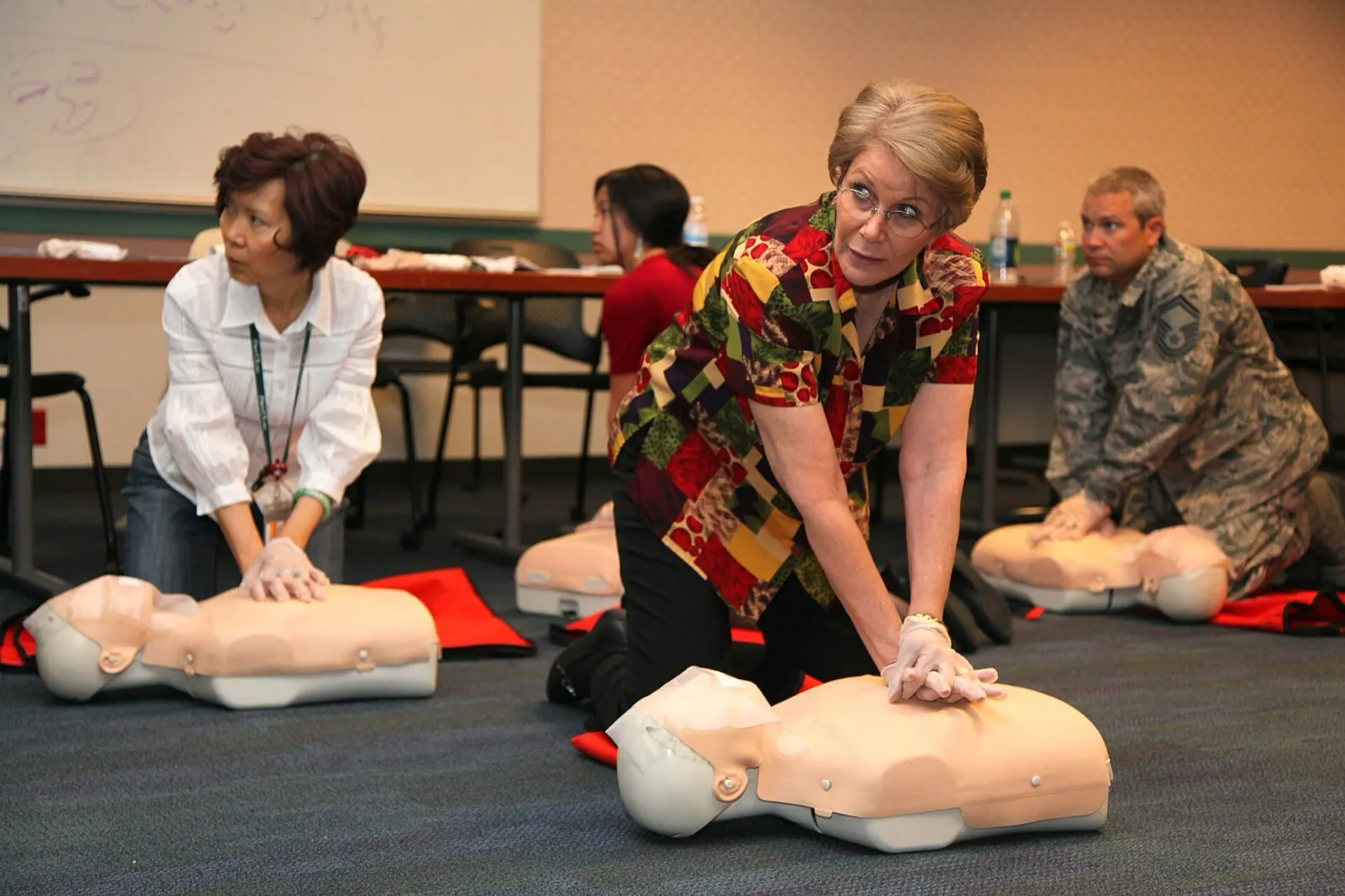
| 4 | First aid and CPR from a certified instructor | Wisconsin, Oregon, Louisiana, Minnesota, Georgia, New Jersey |
| 5 | Defensive driving course, then a behind-the-wheel evaluation | Louisiana, Oregon, Minnesota, MTM Health, Modivcare |
| 6 and 7 | Ride-alongs with a trainer, trip paperwork practice, solo sign-off | Broker documentation rules |
Day 1: rules, conduct, and privacy
- Explain the levels of service. Virginia requires the level of assistance shown on the manifest: curb-to-curb, door-to-door, or hand-to-hand.
- Cover conduct rules. Virginia bars phone use and headphones while the vehicle moves, and all tobacco and vaping in the vehicle. Drivers show an ID badge at pickup and may touch a rider only to help with boarding, seat belts, or first aid they are trained to give.
- Teach privacy. Virginia requires drivers to keep each rider’s information out of sight of other passengers and never discuss it with anyone not involved in the rider’s care.
- Teach what to report and when. MTM Health’s Virginia handbook scores a failure to report an incident or accident at 3 points, its highest level. Walk through your incident report form.
Day 2: the vehicle
Minnesota’s list is a good model for any state. Before a first ride, drivers learn to run the ramp, lift, and securement devices, what to do and whom to call in an emergency, how to use the fire extinguisher and emergency triangles, how to do the daily inspection, and how to clean up body fluids with the kit. Use the vehicle inspection checklist as the lesson plan.
Days 3 to 5: assistance, first aid, and driving
These are the certified courses, covered in the next two sections. Book outside classes before the driver’s start date so seats are open.
Days 6 and 7: ride-alongs and sign-off
Pair the new driver with an experienced one for real trips. The trainer watches greetings, transfers, securement, driving, and paperwork, then signs off on solo work. The driver ride-along checklist lists what to check.
Passenger assistance and wheelchair securement
This is the training riders notice most. The ADA requires drivers to help with securement systems, ramps, and lifts when needed or asked, and to leave their seat to do it (49 CFR 37.165(f)). Drivers must also allow service animals and portable oxygen, and give riders enough time to board and exit (49 CFR 37.167).
PASS, from the Community Transportation Association of America (CTAA), is the course named in Louisiana’s manual, Modivcare’s driver requirements, and MTM Health’s Virginia handbook. It has two parts:
- PASS Basic. An online or classroom course on safety and sensitivity. As of September 2026 the online version has 19 modules. It qualifies a driver for ambulatory riders.
- Full PASS. Hands-on lift operation and wheelchair and occupant securement, taken within 90 days of the Basic certificate, on a vehicle the driver will carry riders in.
CTAA says PASS certification is valid for two years, so put the renewal date in the driver file. For how PASS compares with state-approved courses, see PASS certification.
Minnesota’s rule shows what a full course covers. Drivers who carry wheelchair users need at least 8 hours, including how aging and disabilities affect mobility and communication, handling wheelchairs on steps, curbs, ramps, and icy ground, assisted and standing transfers, and smooth driving for riders who cannot brace for a sudden stop. Drivers of ambulatory riders need 4 hours, stretcher crews 2 more, and drivers who carry children in car seats 3 more.
Teach securement on your own vans, with your own straps. See the step-by-step wheelchair securement guide and safe passenger transfers.
Defensive driving, first aid, and CPR
Most programs accept courses from outside providers, but they name the format.
| Course | What programs ask for |
|---|---|
| Defensive driving | At least 4 hours in person or virtual, every 3 years (Louisiana). The National Safety Council course or an equivalent within 3 months of hire, every 3 years (Oregon). 4 classroom hours within 45 days, then 2 hours every 3 years (Minnesota). |
| First aid | Red Cross or equivalent before driving, refreshed every 3 years (Wisconsin). At least 4 hours within 45 days, covering shock, bleeding, airways, cold and heat injuries, stroke and heart attack signs, diabetic emergencies, and mental health first aid (Minnesota). |
| CPR | An in-person course with an active certification from a licensed instructor (Louisiana). A current CPR card in the crew member’s hands (New Jersey). Certification kept current (Wisconsin, Oregon). |
Minnesota adds two rules worth copying anywhere: every course includes a proficiency test, and courses are taught in person unless the state preapproves another format. Minnesota’s behind-the-wheel evaluation checks merging, lane changes, turns, backing, railroad crossings, and parking.
HIPAA, fraud, and abuse reporting
These modules protect riders and your contract. HIPAA requires a covered entity to train each new workforce member within a reasonable time, to retrain staff whose work is affected by a material change in its policies, and to document the training (45 CFR 164.530). Keep that documentation for six years.
Brokers go further. MTM Health’s standard agreement makes fraud, waste, and abuse and HIPAA part of every driver training program. Its Virginia handbook adds mandatory reporter training on suspected abuse, neglect, and exploitation. Minnesota requires 4 hours of abuse prevention covering sexual misconduct, protection of vulnerable adults, maltreatment of minors, and reporting duties, with 2 more hours every 3 years.
Keep examples concrete for drivers: never read a rider’s diagnosis aloud, keep the manifest out of other riders’ view, and never accept cash or gifts from riders. Virginia bars drivers from soliciting or accepting money, goods, or more business from members.
Trip paperwork drivers must get right
A trip is only paid if the record backs it up, so paperwork belongs in training, not just in the office. Arizona’s Daily Trip Report rules (AHCCCS manual, revised July 31, 2026) show what auditors check:
- The driver prints a full name and signs. Initials, stamps, and typed names do not count.
- The driver never signs for a rider, even when the driver is also a family member or caregiver.
- Mistakes get a single line through them. No erasures or correction fluid.
- Records with missing information are subject to audit error and recoupment.
Practice on real forms during ride-alongs: odometer readings, pickup and drop-off times, signatures, and what to record for a no-show. See NEMT trip documentation and the free trip log template.
Extra training for stretcher crews and special cases
Some drivers need more than the core courses.
- Stretcher van crews in Virginia. The driver and assistant both complete state-approved training in first aid, bloodborne pathogens, and moving and loading riders on stretchers. See stretcher training for NEMT crews.
- Drivers who may contact blood or body fluids. If that contact can be expected on the job, such as during cleanup or first aid, OSHA’s bloodborne pathogens standard applies to those employees. Training is due at assignment and at least yearly, at no cost to them and during working hours, and records are kept 3 years (29 CFR 1910.1030).
- Contracts with transit agencies. If you drive for a transit agency funded by the Federal Transit Administration, each covered driver needs at least 60 minutes of drug awareness training. Supervisors who make reasonable suspicion calls need 60 minutes on drugs and 60 on alcohol (49 CFR 655.14).
- New Jersey oxygen. If your mobility assistance vehicle carries oxygen equipment, other than a rider’s own supply, the crew member must be an EMT with CPR certification.
How to document training for audits
Brokers and states check training in audits, so the file matters as much as the class.
- Keep a certificate for every course in each driver’s file, with the completion date and the next due date. MTM Health’s agreement lists training certificates among required driver file contents, and Georgia’s broker keeps first aid and driver training certificates for each driver. Start with the driver file checklist.
- Log in-house sessions with the date, topic, trainer, hours, and the driver’s signature. The driver training log has columns for each.
- Update your broker roster. MTM Health’s Virginia roster asks for PASS, HIPAA, defensive driving, first aid, and securement dates for each driver.
- Set reminders 60 days before each expiration. MTM Health’s Virginia handbook requires training to be finished before any credential expires.
- Pay for the time. For employees, required training counts as hours worked under federal wage rules (29 CFR 785.27 to 785.29). Whether your drivers are employees at all is covered in NEMT drivers: 1099 or W-2.
Frequently asked questions
Is PASS certification required for NEMT drivers?
It depends on your state and broker. Louisiana requires PASS and wheelchair securement before any Medicaid ride, renewed at least every two years (Medicaid Services Manual, issued July 14, 2025). Modivcare's driver requirements and MTM Health's Virginia handbook (approved August 10, 2026) both list PASS. Other programs name their own course, such as New Jersey's PAT or MAV technician card.
How long does NEMT driver training take?
Plan on about a week before a new driver rides solo. Minnesota's rules show the scale: 4 hours of first aid, 4 hours of classroom defensive driving, 4 hours of abuse prevention, and 8 hours of passenger assistance for wheelchair drivers, plus a behind-the-wheel evaluation and orientation. Louisiana requires a defensive driving course of at least 4 hours.
Can NEMT drivers take their training online?
Some of it. Louisiana requires CPR in person and in-person wheelchair securement for drivers at companies with wheelchair vans, while its defensive driving course may be in person or virtual. Minnesota requires a proficiency test in every course, and in-person teaching unless the state preapproves another format. CTAA's PASS Basic course can be taken online, while full PASS adds hands-on lift and securement training on a vehicle.
How often do NEMT drivers renew training?
Most courses renew every two or three years. PASS certification is valid for two years, and Louisiana renews PASS and securement at least every two years. Defensive driving renews every three years in Louisiana and Oregon. Wisconsin requires a first aid refresher every three years and current CPR. Illinois requires its safety training every three years.
Do I have to pay drivers for training time?
For employees, yes, when you require the training. Under federal wage rules, training can be left off the clock only when it is outside regular hours, truly voluntary, not directly related to the job, and involves no productive work (29 CFR 785.27). Training you require is not voluntary (29 CFR 785.28), so count the hours toward minimum wage and overtime.
Can I use my own training program instead of the broker's?
Often, with written approval. Virginia lets a provider run its own program if the broker approves in writing that it meets or exceeds the state's NEMT driver training requirements (DMAS, updated May 26, 2026). Illinois allows in-house safety training for medicar and service car providers licensed by the state health department, once HFS approves the curriculum.
Official resources
- CMS: Medicaid Transportation Coverage Guide (SMD 23-006)
- eCFR: 49 CFR 37.173, ADA training requirement for transportation providers
- eCFR: 45 CFR 164.530, HIPAA training and documentation
- Minnesota Rules 8840.5910, the most detailed state training list
- Virginia DMAS: NEMT Driver, Attendant, and Vehicle Requirements
- Louisiana Medicaid Services Manual, Chapter 10: Medical Transportation
- CTAA: PASS driver training
- eCFR: 29 CFR 1910.1030, OSHA bloodborne pathogens standard