Drivers and vehicles
Buying a Used Wheelchair Van for NEMT in 2027: What to Inspect Before You Pay
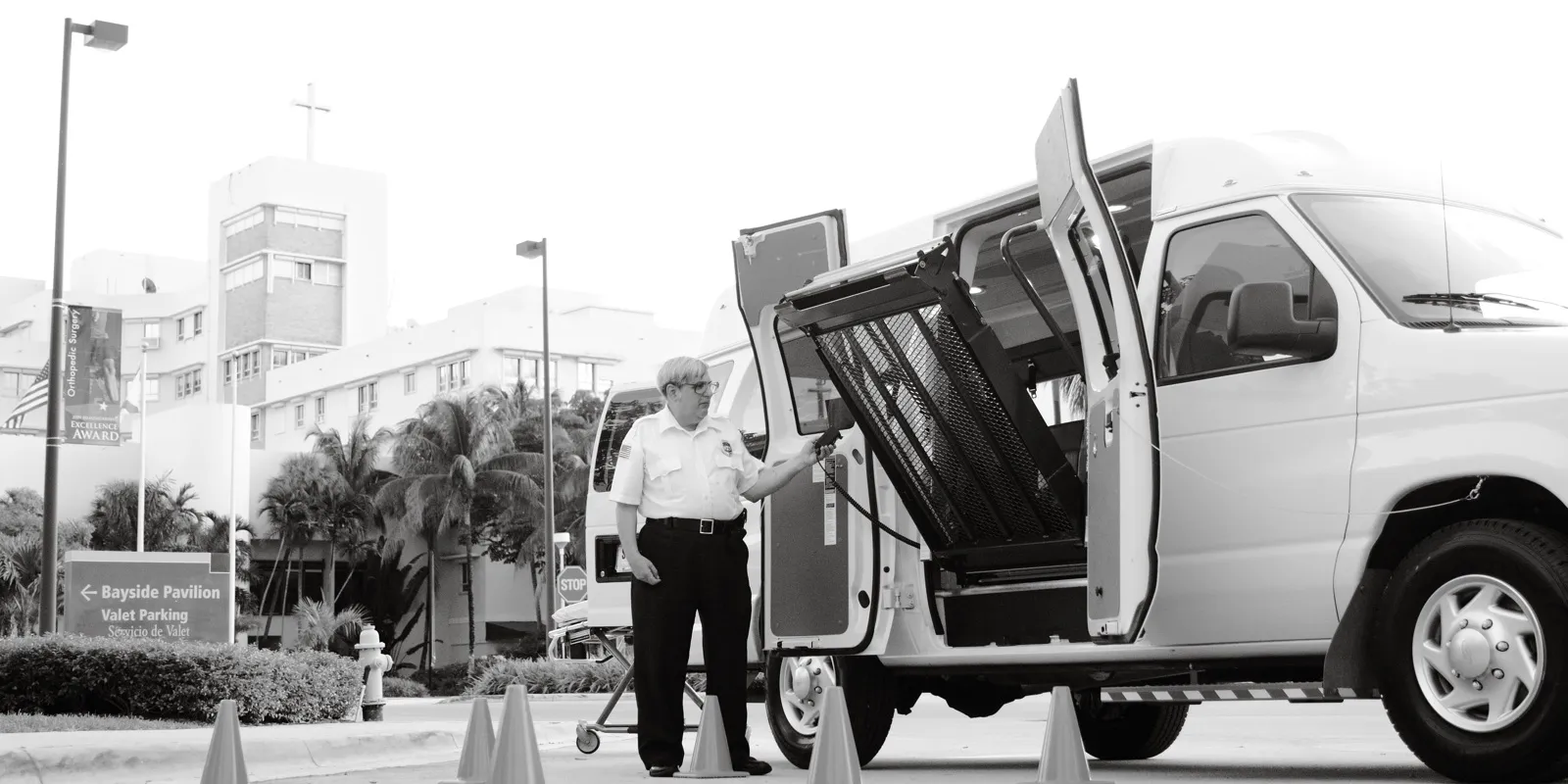
Before you buy a used wheelchair van for NEMT, confirm your brokers will accept its age and miles, then inspect it the way a broker inspector will. Check the conversion and lift labels, read the lift's cycle counter against its service records, test the interlock and manual backup, check every tie-down and belt, search recalls for the van and its equipment, and pull a title history.
- Ask each broker for its vehicle age and mileage limits first. Rhode Island takes no newly added van older than four model years or over 150,000 miles.
- A van converted before its first sale should carry the converter's label next to the original certification label, and a lift built since April 1, 2005 should carry a DOT lift label.
- Every certified lift has a cycle counter and a maintenance schedule tied to it, so compare the count with the service records.
- Recalls on lifts and tie-down retractors are often filed by the equipment maker, so search the equipment as well as the VIN.
- A clean title history is not an inspection. Pay a mechanic and a lift technician to look before money changes hands.
A used wheelchair van can cost far less than a new one. The catch is that the parts that make it a wheelchair van are the parts that wear: the lift or ramp, the tie-downs, the power door, and the suspension that carries the extra weight. In programs like Virginia’s, an inspector checks those parts before the van carries a single member, so check them before you pay. For prices, new against used, see wheelchair van cost.
Check your brokers’ rules before you shop
No federal rule caps a NEMT vehicle’s age or mileage. States and brokers set the limits, and a van that fails one of them is a van you cannot use for that broker’s trips.
| Program | Rule a used van must meet |
|---|---|
| Rhode Island, vehicles added after July 31, 2024 | No more than four model years old and no more than 150,000 miles at the first inspection, then eligible until 250,000 miles, with a yearly inspection (EOHHS policy, September 16, 2024) |
| Virginia | Must meet the federal ADA vehicle specifications in 49 CFR part 38 before approval, pass inspection before carrying members, and be inspected again every six months (DMAS requirements, May 26, 2026) |
| Virginia, wheelchair lifts | The broker records each lift’s age, maker, model number, and stated lifting capacity, and routes trips by that capacity |
| Virginia, condition | Rear air conditioning that reaches 68 degrees and heat that reaches 74, and a body free of rust, major dents, and body damage |
Before you look at vans, ask each broker in writing:
- Is there an age or mileage limit for a vehicle added now?
- Do you prefer a lift or a ramp for your trips, and what lift capacity do you need for heavier riders?
- How many wheelchair positions does a van need to get the trips you plan to run?
- When and where is the vehicle inspection, and what fails most often?
Then get an insurance quote on the exact VIN before you commit. The full list of federal, state, and broker specs is in NEMT vehicle requirements, and choosing a wheelchair van for NEMT covers side or rear entry and seating layouts.
Where used wheelchair vans come from
| Source | What you usually get | What to watch |
|---|---|---|
| Mobility dealer | A van from a business that sells and services conversions, sometimes with a written warranty | The FTC Buyers Guide applies only to vans under 8,500 pounds GVWR, 6,000 pounds curb weight, and 46 square feet of frontal area. Get any promise in writing. |
| Another NEMT company | Often service records and past broker inspection reports | High miles and hard daily use. Ask for the last broker inspection reports. |
| Transit agency or government surplus sale | A van built for daily passenger service | Heavy use. FTA’s minimum useful life for vans is 4 years or 100,000 miles, whichever comes first, and an agency that bought a van with FTA funds needs FTA’s written approval to sell it sooner. |
| Private owner | A van set up for one family’s needs | It was built for one person’s chair. Check that the lift, securement, and belts meet your broker’s specs. |
Paperwork and labels to check first
Most problems show up on paper before you ever cycle the lift. Work through these in order.
- Match the VIN everywhere. The VIN on the windshield, the door label, the title, and the seller’s records should agree. NHTSA’s free vPIC decoder shows the year, make, and model the VIN belongs to.
- Read the certification label. Federal rules place it on the driver’s door edge, the door post, or the hinge pillar next to the driver’s seat (49 CFR 567.4). It lists the date of manufacture and the gross vehicle weight rating (GVWR).
- Find the converter’s label next to it. A company that converts a certified van before its first retail sale must add a label naming the company, the month and year the work was finished, and a statement that the van still meets federal safety standards (49 CFR 567.3 and 567.7). If the conversion changed the GVWR, the new rating must be on that label. A converted van with no second label needs an explanation, such as a conversion done after the van was first sold.
- Find the lift’s certification label. Lifts made on or after April 1, 2005 must be certified to FMVSS 403 and carry a label reading DOT Public Use Lift or DOT Private Use Lift. A public use lift is tested with a 600-pound load. A private use lift is tested at the maker’s rated load or 400 pounds, whichever is greater. The ADA lift specification in 49 CFR 38.23, which programs such as Virginia’s require, calls for a 600-pound design load, so check the rated capacity of any private use lift.
- Look for the instructions. FMVSS 404 requires operating instructions, including backup operation, permanently posted next to the lift controls on vans built since July 1, 2005. The lift maker must also supply an owner’s manual insert with a maintenance schedule.
- Collect the service records for the lift or ramp, the power door, and the van itself.
- Pull an NMVTIS vehicle history report. It covers five things: the current title state and last title date, brand history such as junk, salvage, or flood, the latest odometer reading on the title record, total loss history, and salvage history. It does not include repair history. The Justice Department says it is not a substitute for an independent inspection.
- Check the title for liens and brands, and confirm the odometer disclosure. Model year 2011 and newer vans need one when they change hands, until they are 20 years old. Model year 2010 and older vans, and vans rated over 16,000 pounds GVWR, are exempt (49 CFR 580.17).
Check recalls on the van and its equipment
Start with the VIN on NHTSA’s recall site. NHTSA says its VIN search will not show safety recalls more than 15 years old, recalls by some small manufacturers and specialty vehicle makers, or recent recalls whose VINs are still being added. The same site lets you search equipment by maker and model, so search the lift, the tie-down retractors, and the converter too.
Recent recalls show why the equipment search matters:
| NHTSA recall | Filed | What is recalled | Problem |
|---|---|---|---|
| 25E063000 | September 30, 2025 | About 6,200 QRT-Deluxe and QRT-Max wheelchair retractors | The retractors may not lock, so the chair may not be secured |
| 25V759000 | October 2025 | About 2,810 Braun 2021 to 2025 Chrysler Pacifica, 2022 to 2025 Toyota Sienna, and 2022 to 2026 Honda Odyssey wheelchair vans | Wheelchair retractors that may not lock |
| 25V877000 | December 17, 2025 | About 1,019 Vantage Mobility Honda Odyssey, Chrysler Pacifica, and Toyota Sienna wheelchair vans | QRT-Deluxe and QRT-Max retractors that may not lock |
| 26E022000 | April 20, 2026 | About 7,500 QRT-3 wheelchair retractors | The retractors may not lock |
| 26E038000 | June 23, 2026 | About 1,220 Ricon S-Series and K-Series wheelchair lifts | An electrical contactor may fail, so the controls cannot stop the lift |
Each of those remedies is free. Federal law requires the maker to fix a recalled vehicle or piece of equipment without charge, unless the first buyer bought it more than 15 calendar years before the recall notice (49 U.S.C. 30120). Ask the seller for proof that open recalls were repaired. If there is none, call the maker’s customer service number listed in the recall before you buy.
How to test the lift
Test it yourself first, so you know what to ask the technician. Park on level ground with the van in park and the brake set.
- Run three full cycles empty. Deploy, lower to the ground, raise to the floor, and stow. Watch for jerks, grinding, fluid leaks, and slow spots. With a passenger aboard, no part of the platform may move faster than 6 inches a second (49 CFR 38.23).
- Test the interlock. With the lift deployed, try to shift out of park. The van must not move. With the van in gear, the lift must not deploy. The ADA specs require this interlock, and Virginia requires it to work.
- Let go of the controls mid-cycle. The lift should stop. Where controls are provided, they must need continuous pressure.
- Run the manual backup. Lower and raise the platform with the manual backup, the way a driver would if power failed with a rider aboard. Every certified lift must have one.
- Check the barriers. The outer barrier must be up whenever an occupied platform is more than 3 inches above the ground, or an interlock must stop the lift from rising until it is. The side barriers must be at least 1.5 inches high. The inner roll stop must deploy.
- Measure the platform. It needs at least 28.5 inches of clear width at the surface, 30 inches of width from 2 to 30 inches above it, and 48 inches of length.
- Check the handrails. There must be one on each side that moves with the platform, between 30 and 38 inches above it.
- Check the door height. On a van 22 feet long or less, there must be at least 56 inches between the top of the door opening and the raised platform (49 CFR 38.25).
- Check the warning signals. A public use lift must flash a red light and sound an alarm when someone is on the threshold and the platform is more than 1 inch below the floor.
- Read the cycle counter. FMVSS 403 requires a counter that records every complete raise and lower, and a maintenance schedule based at least partly on that count. Compare the reading with the service records.
For scale, FMVSS 403’s fatigue test runs a public use lift through 15,600 cycles and a private use lift through 4,400. That is a test, not a lifespan. A count in the thousands with no service record is a reason for a closer look.
If the van has a ramp instead
A ramp needs a clear width of 30 inches and side barriers at least 2 inches high. A ramp 30 inches or longer must support 600 pounds. Deployed to the ground, it can be no steeper than 1 inch of rise for every 4 inches of length. When it is in use, it must be firmly attached, with no gap over 5/8 inch between the ramp and the van. Check the hinges and the stowage latch, and look underneath for bends or cracks. See wheelchair ramp or lift for which fits your riders.
Check the securement stations and belts
The securement system is what keeps a rider safe in a crash, and it wears quietly.
- Count the stations. A van 22 feet long or less needs at least one. Each needs a clear floor space of 30 by 48 inches (49 CFR 38.23).
- Check the belts. Every station needs its own lap and shoulder belt, separate from the tie-downs that hold the chair. Virginia also requires four working securements at each station.
- Pull each retractor sharply. It should lock. Then check the recall list above for the retractor model.
- Inspect the webbing, hooks, and floor tracks. Replace frayed or cut straps. Look for cracks, rust, and loose bolts where the tracks and anchors meet the floor.
- Check the direction. In a van 22 feet or less, the chair may face forward, or face rearward with a padded barrier behind the rider.
- Know the standard. In vehicles rated up to 30,000 pounds GVWR, the system must hold 2,500 pounds per securement leg and 5,000 pounds per chair, and limit chair movement to 2 inches. You cannot test that in a parking lot, so rely on condition, labels, and records.
Wheelchair securement walks through how each station is used on every trip.
Inspect the body, floor, and climate
Conversions cut into the body and floor, and those are the areas that rust.
- Look underneath at the floor pan, the lift or ramp mounting points, and the sliding door track. Rust at a mount is a reason to walk away.
- Check a lowered floor for scrapes and damage underneath. A lowered floor van sits closer to the road.
- Check the weight rating. Compare the GVWR on the label with what you plan to carry: the driver, riders, heavy power chairs, and equipment. Look at tire wear and ride height for signs of overloading.
- Test the climate at the rear. Virginia requires air conditioning that cools to 68 degrees and heat that reaches 74, measured from the rear of the vehicle.
- Check the interior. Virginia bars torn upholstery, broken seats, and sharp edges, and requires an accurate speedometer and odometer.
- Try every power feature: sliding door, kneeling system, lights, and the lift’s power source.
Get a pre-purchase inspection
Pay for two inspections before money changes hands. A mechanic checks the engine, transmission, brakes, suspension, and frame. A technician trained on that lift or ramp brand checks the conversion, runs a loaded test, and reads the service history against the maker’s schedule.
Bring the list from this page and your broker’s inspection form. Use what they find to negotiate or to walk away. After you buy, book the broker inspection right away, before you schedule any trips.
Close the deal
Buying from a dealer. Under the FTC Used Car Rule, a dealer that sold or offered five or more used vehicles in the past 12 months must post a Buyers Guide on each used vehicle it offers. The Guide says whether the vehicle is sold as is or with a warranty, and it becomes part of the sales contract, overriding anything in the contract that says otherwise. Under the rule, a consumer is anyone who is not a used vehicle dealer. The rule covers only vehicles rated under 8,500 pounds GVWR, under 6,000 pounds curb weight, and under 46 square feet of frontal area. Check the GVWR on the door label, and if the van is outside the rule, get every promise in writing. Some states limit as-is sales.
The paperwork. Title the van in your company’s name and get a lien release if there was a loan. List the lift or ramp make, model, serial number, and cycle count on the bill of sale. Have insurance active before you drive away.
Getting it ready for trips. Add the signs your program requires. Virginia wants your business name and phone number on both sides in letters at least 3 inches high. Then schedule the broker inspection.
Paying for it. The wheelchair van loan calculator shows the monthly payment and the trips needed to cover it. Depreciation and Section 179 rules are in wheelchair van cost.
Used wheelchair van inspection checklist
Print this and take it to every van you look at.
| Area | What to check | Walk away or renegotiate if |
|---|---|---|
| Broker fit | Age, miles, and lift or ramp type meet each broker’s rules | It fails any broker’s limit |
| VIN and labels | VIN matches the title and door label; converter’s label and lift label present | VINs do not match, or a converted van has no converter’s label |
| Title history | NMVTIS report and title show no brands or liens | Salvage, flood, junk, or total loss history |
| Recalls | No open recalls on the van, lift, or retractors | An open recall with no repair |
| Lift | Three clean cycles, interlock, manual backup, barriers, handrails, warning signals | The interlock or backup fails, or the platform drops or jerks |
| Lift records | Cycle count matches a service history on the maker’s schedule | A high count with no records |
| Ramp | 30-inch width, 2-inch barriers, firm attachment, no bends | Cracks, bends, or a gap over 5/8 inch |
| Securement | Four tie-downs and a lap and shoulder belt at each station; retractors lock | Frayed straps, cracked tracks, a retractor that will not lock |
| Door height | At least 56 inches on vans 22 feet or less | Less than 56 inches between the door top and the raised platform |
| Body and floor | No rust at mounts, floor pan, or door tracks | Rust through or at a lift mount |
| Climate | Rear air reaches 68 degrees and heat reaches 74 | Either fails |
| Chassis | Mechanic’s inspection passed | Major engine, transmission, brake, or frame problems |
Once the van is yours, check it before every shift with the free vehicle inspection checklist, and log every lift service in a vehicle maintenance log.
Frequently asked questions
How old can a used wheelchair van be for NEMT?
No federal rule caps a NEMT van's age, so states and brokers set the limit. Rhode Island accepts vehicles added after July 31, 2024 only if they are no more than four model years old with no more than 150,000 miles at the first inspection, and they can serve until 250,000 miles. Ask every broker you work with for its limit in writing before you shop.
Can I use a family's used wheelchair van for NEMT?
Only if it passes your broker's inspection. Virginia, for example, requires every NEMT vehicle to meet the federal ADA vehicle specifications in 49 CFR part 38 before it is approved. Among other specs, that means a lift with a 600-pound design load or a ramp that meets the ADA ramp rules, at least 56 inches of door clearance on a van 22 feet long or less, and a 30 by 48 inch securement space with a lap and shoulder belt.
How do I check a used wheelchair van for recalls?
Search the VIN on NHTSA's recall site, then search the lift, the tie-down retractors, and the converter by maker and model on the same site. The VIN search does not show recalls more than 15 years old or some recalls by small and specialty manufacturers. The maker must fix a recall for free unless the van or equipment was first bought more than 15 years before the recall notice.
What does the lift cycle counter tell me?
Federal Motor Vehicle Safety Standard 403 requires every certified platform lift to have a counter that records each complete raise and lower. The lift maker's owner's manual insert must include a maintenance schedule based at least partly on that count. Compare the reading with the service records. A high count with no service history is a reason to pay a lift technician before you buy.
Does a dealer have to give a warranty on a used wheelchair van?
Not under federal law, but most dealers must tell you in writing. Under the FTC Used Car Rule, a dealer that sold or offered five or more used vehicles in the past 12 months must post a Buyers Guide saying whether the vehicle is sold as is or with a warranty. The rule covers only vehicles with a gross vehicle weight rating under 8,500 pounds, a curb weight under 6,000 pounds, and a frontal area under 46 square feet, so heavier or taller vans can fall outside it. Some states limit as-is sales.
Does the seller have to disclose the van's mileage?
For most vans, yes. Federal odometer rules require a mileage disclosure when a model year 2011 or newer vehicle changes hands, until it is 20 years old. Model year 2010 and older vehicles are exempt, and so are vehicles with a gross vehicle weight rating over 16,000 pounds. Compare the disclosed reading with the odometer, the title history report, and the service records.
Official resources
- NHTSA: Check for recalls by VIN or equipment
- NHTSA: vPIC VIN decoder
- DOJ: NMVTIS vehicle history reports and approved data providers
- eCFR: 49 CFR 38.23, Lift, ramp, and securement specifications
- eCFR: 49 CFR 571.403, FMVSS 403 platform lift standard
- eCFR: 16 CFR part 455, FTC Used Car Rule and Buyers Guide