Drivers and vehicles
Wheelchair Van Emergency Evacuation in 2027: A Driver Drill for Fire, Crashes, and Lift Failure
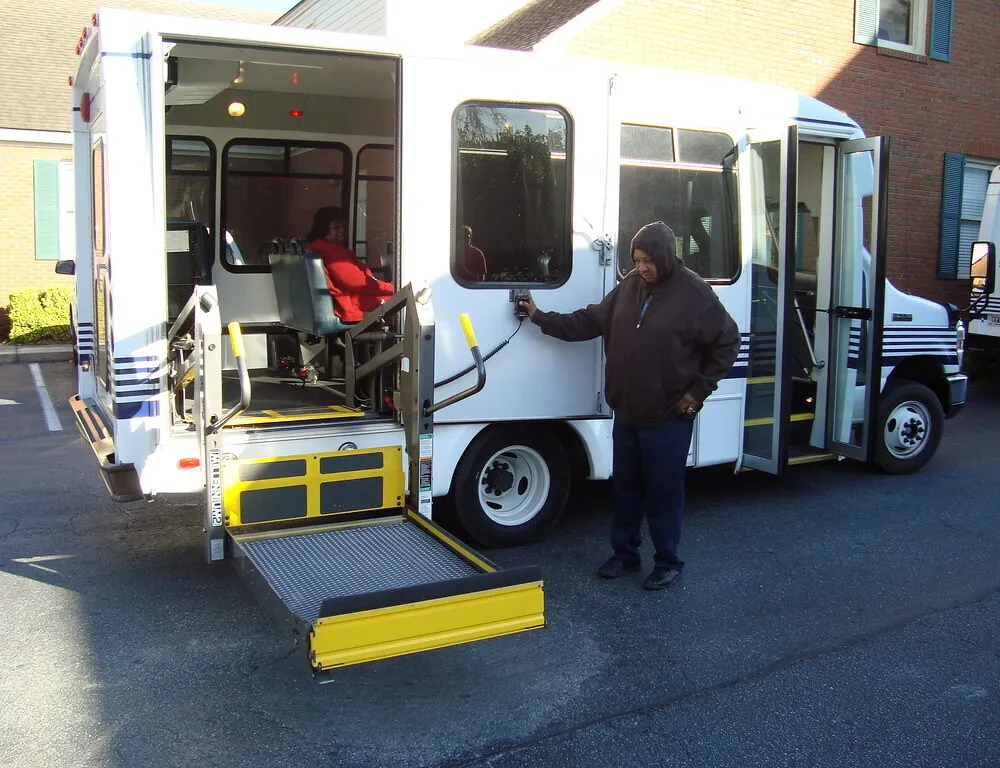
Overview
Wheelchair van emergency evacuation means getting every rider out when staying aboard is more dangerous than leaving: fire, smoke, leaking fuel, or a van stuck on rail tracks. Riders who can walk usually go first. Then release each wheelchair rider's belt and tie-downs, cutting any strap that will not give, and lower the lift with its manual backup. Drill it in every van.
- Empty the van only when staying is more dangerous: fire, smoke, leaking fuel, rail tracks, or a spot where traffic cannot see you.
- Every platform lift built since April 1, 2005 must have a manual backup that lowers an occupied platform, with instructions posted near the controls.
- Free the rider's belt first, then the four tie-downs. Cut any strap that stays locked.
- Manual lift controls differ by model. One lift maker says to open the release valve half a turn, another only a quarter turn.
- Drill every driver in the van they drive, with the cutter in hand, at hire and every year.
Most bad days in a wheelchair van end with everyone staying in their seats. The rare exception is a fire, a van stalled on rail tracks, or a crash that leaves leaking fuel, and then the driver has a minute or two to get people out who cannot get out alone. This guide is the drill for that minute: when to go, who leaves first, how to free a chair fast, and how to lower a lift by hand.
When to get riders out, and when to stay put
Staying in the van is the default after a breakdown or a minor crash. The breakdown guide covers the roadside routine for that case. Ask one question before you move anyone: is each rider safer outside the van than in it?
Get everyone out at once for any of these:
- Fire or smoke. Federal Transit Administration guidance (August 2018) says bus fire simulations show dense smoke can fill a bus in one to two minutes. The U.S. Fire Administration says to turn off the engine, get everyone out, never go back in, and never open a hood or trunk that may have fire under it.
- Leaking fuel or nearby flames. Alabama’s school bus driver handbook (revised January 2024) treats being near fuel or other combustible material as danger of fire.
- A van stuck on rail tracks. If a train is coming, Washington’s school bus driver handbook (revised March 2019) says to get everyone out and walk toward the train at a 45 degree angle away from the tracks.
- A van in a dangerous spot. Alabama lists a stop where the vehicle could slide into water or over an edge, and a stop over a hill or around a curve where other drivers cannot see it from 300 feet.
Stay inside for these:
- A possible spinal injury, with no fire. MedlinePlus (reviewed June 4, 2025) says never to move someone who may have a spinal injury unless it is absolutely necessary, such as getting them out of a burning car.
- Downed power lines on the van. Washington tells drivers to stay inside and not move until line crews say the power is off. If fire forces you out, jump clear without touching the van and the ground at the same time, land with feet together, and shuffle away.
- A flat tire, deep snow, extreme cold, or lightning. Alabama does not treat these alone as reasons to unload.
Who comes out first
The driver goes first in one sense: you cannot help anyone while you are belted in. The FTA guide recommends keeping a web cutter near the driver’s seat so a driver can cut their own belt before helping riders. Park, set the brake, turn off the engine, and turn on the flashers.
Then work in this order, unless a rider is right beside the danger:
- Riders who can walk and follow directions. Send them out first to a meeting spot at least 100 feet from the van and away from traffic, the distance the U.S. Fire Administration gives. They clear the aisle and the door the wheelchairs need.
- Riders who may wander off. Washington’s handbook tells drivers to know which riders might walk or run away in an emergency. Send them out with a helper, or bring them out with the last rider so someone stays beside them.
- Wheelchair riders, nearest the exit first. Free each chair the way the next section shows.
- Anyone who cannot come out in a chair. If a chair is stuck and the van is burning, the person comes out without it. The FTA guide says smoke and toxic gas rise toward the ceiling, so drivers should stay low and use clothing or shoulder drags rather than a strap drag.
Count heads at the meeting spot. Never go back in.
Know your second exit before you need it. On cutaway buses, the FTA notes, the wheelchair lift most often sits at the right rear side door and blocks it, and an engine fire can make the right front door useless. That is why it recommends buying cutaways with a rear emergency door rather than a rear emergency window. Under federal motor carrier rules, any vehicle built or used to carry passengers counts as a bus (49 CFR 390.5T). When yours is a commercial motor vehicle on interstate trips, bags and gear may never block any rider’s way to an exit (49 CFR 392.62).
Write the order down for each regular route. Washington recommends a written evacuation plan for each route, kept with the route papers for substitute drivers and revised whenever riders change. Part 9 of the NEMT emergency plan template has the blanks.
How to free a wheelchair fast
Free the rider first, then the chair. Q’Straint’s QRT instructions release the rider’s shoulder and lap belts first, then unhook the front and rear tie-downs. With the belt off first, the rider is never strapped to a chair that is about to move.
Three ways to free each strap, from fastest to last resort:
- The retractor release. Most retractors have a release button or lever that lets the webbing pay out. Q’Straint’s QRT retractors use red release levers, and its QRT Max has a foot release lever. Sure-Lok’s training guide says to press the red release button on its Retraktor to loosen the belt.
- The floor fitting. A strap can come off the floor instead of the chair. Sure-Lok’s guide says to lift the plunger on an L-track fitting and slide it before lifting it out, and to press the keeper on an A-track fitting and slide it out.
- The cutter. Cut any strap that will not let go. Sure-Lok’s guide says every vehicle should carry a web cutter for emergency evacuation.
A power chair may not roll with its motor engaged. Alabama’s handbook has drivers disengage a power chair’s gears so it can be moved by hand. Learn how that works on each regular rider’s chair before the day you need it. The wheelchair securement guide covers the strap order and anchor points in detail.
How to lower a wheelchair lift by hand
Federal standard FMVSS 403 covers every platform lift made on or after April 1, 2005. Each one must have a manual backup that, after a power loss or a malfunction, can unfold the lift, lower a loaded platform to the ground, raise the empty platform, and stow it (S6.9.1). The outer barrier and inner roll stop must work by hand in backup mode. The ADA vehicle rules add that no emergency method may let an occupied platform fold or stow (49 CFR 38.23(b)(3)).
The instructions are required to be in the van. FMVSS 403 puts simple operating instructions, backup steps included, near the lift controls and in the lift insert to the vehicle owner’s manual. For vans made on or after July 1, 2005, FMVSS 404 requires those instructions permanently fixed beside the controls. If yours are missing or unreadable, get a copy from the lift maker before the van carries another wheelchair rider.
Two safety features may not work in backup mode. FMVSS 403 does not require the lift’s interlocks or its threshold warning to work during manual operation, and Ricon’s manual confirms the warning is off. So you check by eye that the outer barrier is up and the rider is centered before the platform moves.
Most hydraulic lifts use a pump handle and a release valve, but the details differ:
- BraunAbility Century 2. Its operator manual (33702, Rev. G) puts a manual operation decal on the pump cover. To lower, set the slotted end of the pump handle on the backup release valve and turn it counterclockwise, opening it half a turn only. Close the valve before you use the electric pump again, and store the handle in its clamps.
- Ricon S-Series. Its manual (September 2020) recommends manual operation only for getting passengers out. Lift the bridgeplate by hand to free the stow lock, center the chair facing out with its brakes on, and open the release valve no more than a quarter turn. Opening it further can separate the valve from the pump and disable the manual pump.
Ramp minivans have their own backup. Vantage Mobility’s 2026 Toyota Sienna Hybrid Northstar manual says to turn the ramp switch off, then turn the in-floor ramp out with the wrench stored under the rear bench, or pull it out by hand while standing outside. Its sliding door opens by hand only once the vehicle’s power door switch is off.
A manual lowering, step by step:
- Find the decal on the pump cover or beside the controls, and the pump handle or crank.
- Open the doors by hand if the power doors are dead, and check the ground below the platform is clear.
- Unfold the platform with the hand pump or crank, as the decal shows.
- Roll the rider on, centered, with the chair’s brakes set. Ricon’s manual and Alabama’s handbook both have the rider face away from the van on the way down.
- Check the outer barrier is raised before the platform leaves the floor.
- Open the release valve only as far as the decal allows, and stay beside the rider as the platform lowers.
- Close the valve once the platform is down, release the brakes, and roll the rider clear.
Where the cutter and extinguisher belong
The tools only help if they are where the driver can grab them. The emergency plan template lists the full van kit by state. For an evacuation, check these four on every daily inspection:
- Strap cutter. Minnesota requires a tool designed for cutting securement straps, with no exposed sharp edge and not usable as a weapon (Rules 8840.5925, published September 14, 2023). Virginia requires at least one seat belt cutter within easy reach of the driver (updated May 26, 2026). Louisiana’s broker inspection checks the cutter’s location (issued July 14, 2025).
- Fire extinguisher. Virginia requires a working Class A, B, C extinguisher secured within the driver’s easy reach. Minnesota requires a dry chemical extinguisher rated at least 5B:C with a charge gauge, mounted in a bracket. Where your van is a commercial motor vehicle, 49 CFR 393.95 requires one rated 5 B:C, or two rated 4 B:C, with a charge indicator and a secure mount.
- Lift pump handle or ramp wrench. In its clips or under the seat where the manual puts it, never loose in the cabin.
- Flashlight. Minnesota requires one, and night is when a dead lift is hardest to work.
OSHA’s extinguisher rule asks employers to look at each extinguisher monthly, service it yearly, keep the service record, and train employees on extinguisher use at hire and every year after (29 CFR 1910.157). OSHA’s May 18, 1990 letter applied the same servicing rules to extinguishers on private school buses. CareOregon (February 2024) wants drivers trained on the extinguisher in every vehicle they regularly drive.
How to run the evacuation drill
Some programs require the training. TennCare’s contract (Amendment 25, July 1, 2026) has its health plans make sure drivers get at least 32 hours of training before their first ride and 15 hours every year, with emergency evacuation on the list. Minnesota’s special transportation service rules require instruction and a demonstration of the ramp, lift, and securement system before a driver’s first ride, plus fire extinguisher training. Federal ADA rules require drivers to be trained to proficiency on the vehicle and its equipment (49 CFR 37.173).
The FTA suggests asking the local fire department to teach extinguisher use and evacuation. It also describes training mannequins that let drivers practice dragging a person out of a vehicle and getting someone out of a mobility device without hurting their own back.
Run the drill in a quiet lot, in each van, with a coworker playing the rider:
- Time the start. Park, set the brake, engine off, flashers on.
- Reach the cutter from the driver’s seat without looking, and practice on a scrap strap, never a good one.
- Lead the riders who can walk to a named meeting spot 100 feet away, and count.
- Free a secured chair in order: the rider’s belt first, then the four tie-downs.
- Switch the lift’s power off and run the full manual backup: unfold, lower with the chair aboard, raise empty, stow.
- Practice a low drag on a training mannequin, never on a rider.
- Write it down: date, van, driver, minutes taken, and what slowed you down. Fix that before the next drill.
Repeat at hire, whenever a driver moves to a van with a different lift or ramp, and at least once a year. The driver training guide has a first-week plan to fit it into.
After everyone is out: calls, reports, and equipment
Call 911 for any fire or injury, then dispatch, which calls the broker. The vehicle accident guide has the reporting clocks for police, insurers, and brokers. Write the incident report the same day. TennCare counts any event that interrupts a ride as an incident its health plans must document.
Then replace what was used:
- Securement. Sure-Lok says cut, frayed, or damaged webbing means a whole new strap or belt assembly. Q’Straint says to replace any part suspected of being in use in a crash the van was towed from.
- The lift. BraunAbility says to stop using a lift at any sign of wear, damage, or improper operation, and to close the backup release valve before the electric pump runs again. Log the event in the wheelchair lift inspection log.
- The van. Federal ADA rules require lifts and securements to be repaired promptly, with reasonable steps taken in the meantime for riders who need them (49 CFR 37.161). Send a lift van while this one is out.
Frequently asked questions
Should wheelchair riders stay in the van after a crash?
Usually, yes, unless there is fire, smoke, leaking fuel, or another danger. MedlinePlus says never to move someone who may have a spinal injury unless it is absolutely necessary, such as getting them out of a burning car. Keep the rider secured, call 911, and let emergency crews move anyone who may be hurt.
What if the lift will not work at all?
Use the manual backup. Federal standard FMVSS 403 requires every platform lift made on or after April 1, 2005 to have a manual mode that lowers a loaded platform to the ground if power is lost or the lift malfunctions. If the backup also fails and the van is on fire, the rider has to come out without the lift. Release the chair and move the person to safety, staying low under smoke.
What kind of belt cutter should a wheelchair van carry?
A tool made for cutting webbing, kept where the driver can reach it from the seat. Minnesota requires a tool designed for cutting securement straps, with no exposed sharp edge, that could not be used as a weapon. Virginia requires at least one seat belt cutter within easy reach of the driver, and Louisiana wants it secured within the driver's reach.
Should the driver try to put out a van fire?
Get everyone out first. The U.S. Fire Administration says not to fight a vehicle fire yourself and not to open a hood or trunk that may have fire under it. The Federal Transit Administration says the extinguisher should be used only to clear or hold open the path riders are leaving by. Then move everyone at least 100 feet away and call 911.
How often do drivers need evacuation training?
It depends on your program. TennCare's contract with its health plans (Amendment 25, July 1, 2026) lists emergency evacuation among the topics drivers must be trained on before their first ride and again every year. Minnesota requires lift, ramp, and securement demonstrations and fire extinguisher training before a driver's first ride. A yearly drill in each van is a sound minimum everywhere.
Do straps that were cut or used in a crash need to be replaced?
Yes. Sure-Lok's training guide says cut, frayed, contaminated, or damaged webbing means replacing the entire strap or belt assembly. Q'Straint's QRT instructions say to replace frayed or damaged webbing at once, and any part suspected of being in use in a crash the van had to be towed from. Have the lift checked too before the van carries another wheelchair rider.
Official resources
- eCFR: FMVSS No. 403 (lift manual backup and operating instructions)
- eCFR: 49 CFR 38.23 (ADA lift, ramp, and securement specifications)
- FTA: Effective Practices in Bus Transit Safety, Emergency Response
- U.S. Fire Administration: What to do if your vehicle catches fire
- Minnesota Rules 8840.5925 (vehicle safety equipment, including the strap cutter)
- OSHA: Portable fire extinguisher inspection and training rules (29 CFR 1910.157)