Drivers and vehicles
Electric Wheelchair Vans for NEMT in 2027: Range, Charging, Cold Weather, and Cost
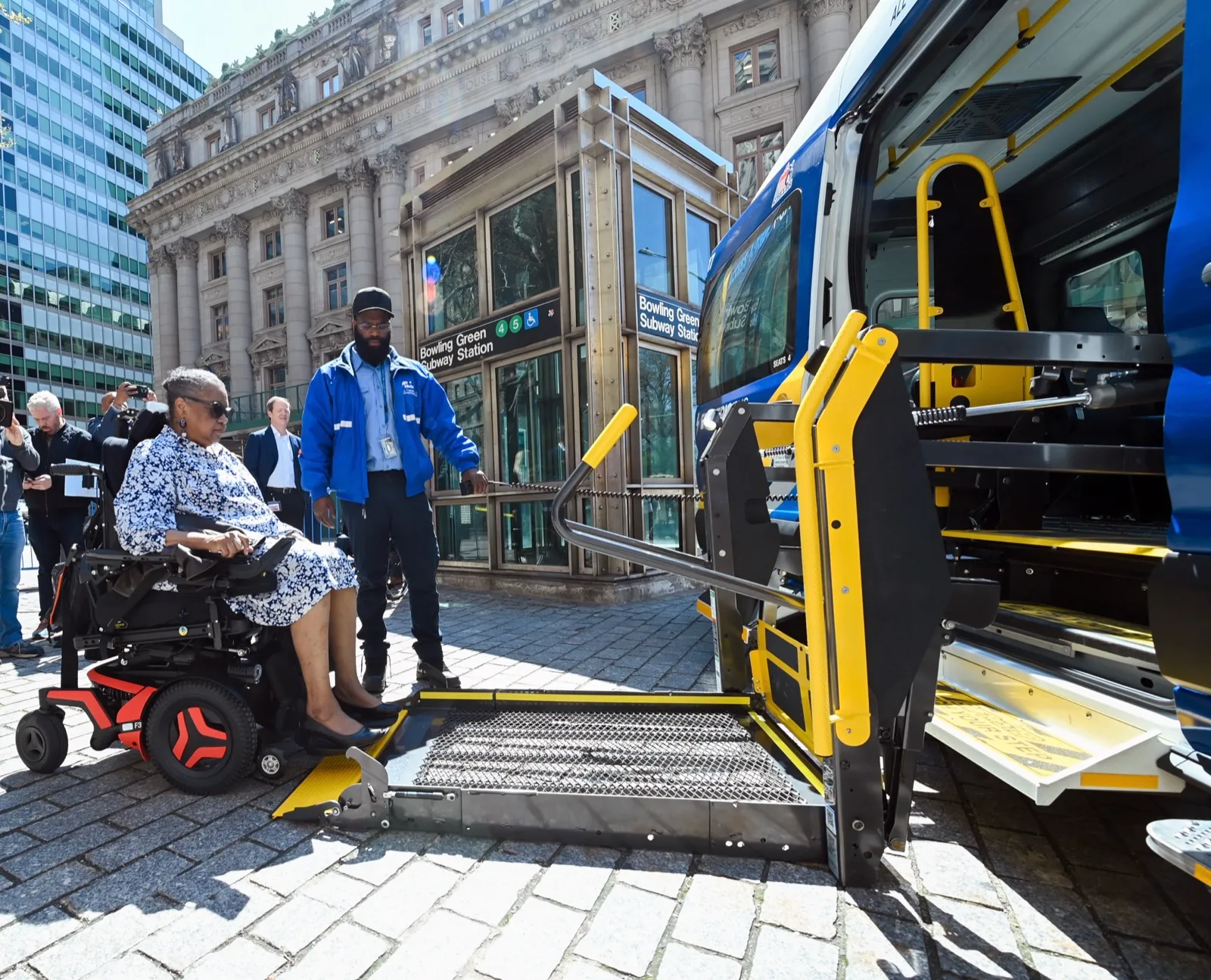
.jpg)
An electric wheelchair van fits NEMT when its winter range covers your longest day. Ford lists 159 miles for the E-Transit, and federal data show EV range can fall 41% at 20°F with the heater on. Electricity costs far less per mile than gas, but Florida's transit contract, revised June 17, 2026, charges $89,189 more for an electric minibus than for the gas one.
- Full-size vans carry no EPA rating, so their range comes from the maker. Ford lists 159 miles for the E-Transit cargo van.
- EV range can drop about 41% at 20°F with the heater on, and Virginia's rules and Arkansas's broker terms require heat to 74°F in the back of the van.
- At July 2026 power prices and late September 2026 gas prices, an EPA-rated electric minivan uses about 5 to 7 cents of power per city mile, against 23.5 cents of gas for a V6 minivan.
- Florida's contract prices an electric minibus $89,189 above the gas version, more than this page's examples save over 200,000 miles.
- The federal commercial clean vehicle credit ended for vans acquired after September 30, 2025, and the charger credit covers only chargers placed in service through June 30, 2026.
An electric wheelchair van trades a cheap mile for an expensive purchase and a hard limit on range. For a NEMT company, the test is simple: will the van finish your longest winter day with riders warm, the lift working, and battery to spare? This guide works through range, charging, the lift, and the cost math with federal numbers.
If you mean a van for a rider in a power wheelchair, any wheelchair van with a lift rated for the chair and rider can carry one. See wheelchair vans for NEMT for layouts and lift ratings.
Which electric wheelchair vans you can buy
The choice is short, and it splits into full-size vans and minivans.
| Vehicle | Type | Range | Charge time | Where the number comes from |
|---|---|---|---|---|
| Ford E-Transit (full-size) | Fully electric | 159 miles, 89 kWh battery | DC fast charging up to 115 kW | Ford, as listed by the federal Alternative Fuels Data Center |
| 2025 Volkswagen ID. Buzz, rear-wheel drive | Fully electric minivan | 234 miles (253 city, 211 highway) | 9 hours from empty at 240 volts | EPA |
| 2025 Volkswagen ID. Buzz 4motion | Fully electric minivan | 231 miles | 9 hours at 240 volts | EPA |
| 2026 Chrysler Pacifica Hybrid | Plug-in hybrid minivan | 32 electric miles, 520 in all | 2 hours at 240 volts | EPA |
| 2026 Toyota Sienna hybrid | Hybrid, no plug | Not an EV: 36 mpg city | None | EPA |
Three points shape what this table means for you:
- Full-size vans have no EPA rating. Cargo vans rated over 8,500 pounds and passenger vans rated 10,000 pounds or more are exempt from EPA fuel economy testing, so the E-Transit’s 159 miles is Ford’s own figure for the cargo van, before a lift, seats, and riders are added. Ask the converter what range it expects from the finished van.
- Electric minivans are few. As of September 30, 2026, the EPA’s fuel economy data lists only two plug-in minivans for the 2025 to 2027 model years: the 2025 ID. Buzz and the Pacifica Hybrid. There is no 2026 ID. Buzz in the file.
- Ratings apply before conversion. A lowered floor, ramp, and tie-downs change the vehicle. Ask each converter which electric models it builds on.
At least one state purchasing contract lists them. Florida’s state transit contract, revised June 17, 2026, offers an electric Ford E-Transit version of its 22-foot Ford Transit minibus, and a 150 kWh or 226 kWh electric drivetrain for its larger Ford E450 cutaway. The same order forms price the wheelchair stations. The prices are in the cost section below.
How much range a NEMT day really needs
Start with your own miles, not the brochure. CMS guidance says Medicaid generally does not pay for miles with no rider aboard, but those deadhead miles still drain the battery.
Miles you need = loaded miles + empty miles + a reserve for detours and a late will-call
Then compare that number with your winter range, not the rated range. FuelEconomy.gov gives the federal figures:
- At 20°F with the cabin heater on, EV range can drop about 41% and fuel economy about 39%, compared with 77°F. About two-thirds of the extra energy heats the cabin.
- Without the heater, range drops only about 12% at 20°F.
- In very hot weather, air conditioning can cut a gas vehicle’s fuel economy by more than 25% on short trips, and the effect on EVs can be even larger on a percentage basis.
You cannot leave the heat off with riders aboard. Virginia’s fee-for-service rules (DMAS, updated May 26, 2026) and Arkansas’s broker terms both require heat to 74 degrees and air conditioning to 68 degrees, measured at the rear of the van.
| Vehicle | Rated range | At 20°F, heater on (about 41% less) | At 20°F, heater off (about 12% less) |
|---|---|---|---|
| Ford E-Transit (Ford’s figure) | 159 miles | About 94 miles | About 140 miles |
| 2025 ID. Buzz, rear-wheel drive | 234 miles | About 138 miles | About 206 miles |
| 2026 Pacifica Hybrid, electric only | 32 miles | About 19 miles, then gas | About 28 miles, then gas |
A van that runs 140 miles on a winter day would need a midday charge in an E-Transit rated at 159. Two habits from FuelEconomy.gov help: warm the cabin while the van is still plugged in, and use seat warmers where they are fitted instead of the cabin heater. For long rural days, see rural NEMT.
Charging: how long it takes and what the equipment costs
The Alternative Fuels Data Center sorts chargers into three levels.
| Level | Power | Typical range added | Best use |
|---|---|---|---|
| Level 1, 120 volt outlet | About 1.9 kW | About 5 miles per hour of charging | A car that sits all night and drives little |
| Level 2, 208 or 240 volt | 2.9 to 19.2 kW. Most home units deliver 7.2 kW on a dedicated 40-amp circuit. | About 25 miles per hour for a typical EV | Overnight charging at your lot |
| DC fast | Up to 500 kW at the station | About 100 to 200 miles or more per 30 minutes | Midday top-ups on long days |
Those range figures assume a typical car. A full-size van uses more energy per mile. Ford’s figures for the E-Transit, 89 kWh and 159 miles, work out to about 0.56 kWh a mile. So:
- An hour on a 7.2 kW charger puts in 7.2 kWh, or about 13 miles of E-Transit range before losses.
- A 10-hour night on that charger puts in 72 kWh, or about 129 miles before losses.
- After charging losses, that night is closer to 108 to 120 miles. FuelEconomy.gov says charging efficiency is often 84% to 93%.
The van’s onboard charger can cap Level 2 speed, whatever the wall unit delivers, so ask for its kW rating. Plan one charger per van if every van charges overnight.
Florida’s transit contract (revised June 17, 2026) shows what buyers on the contract pay for charging stations, before any electrical work your lot needs:
| Charging station on Florida’s contract | Price |
|---|---|
| Level 2, 7.7 kW | $1,502 |
| Level 2, 15.2 kW | $2,241 |
| Level 2, 19.2 kW | $4,422 |
| DC fast, 50 kW | $45,006 |
| DC fast, 150 kW | $78,607 |
Ask an electrician whether your service can carry the chargers you need. Find public fast chargers along your routes with the federal station locator.
Energy cost per mile: gas against electric
Two formulas give your real numbers:
Gas cost per mile = price per gallon ÷ miles per gallon
Electric cost per mile = kWh per mile × price per kWh
In the week of September 28, 2026, regular gas averaged $4.465 a gallon (EIA). Electricity averaged 14.53 cents per kWh for businesses and 18.31 cents for homes in July 2026. Business rates ran from 8.22 cents in North Dakota and 8.47 in Texas to 30.56 in California and 43.63 in Hawaii, so use your own bill.
These are EPA city ratings, which fit NEMT’s short trips, before any conversion:
| 2025 or 2026 vehicle | EPA city rating | Energy per mile at business rates | At home rates |
|---|---|---|---|
| Chrysler Pacifica V6, gas | 19 mpg | $0.235 | $0.235 |
| Chrysler Pacifica Hybrid, on gas | 29 mpg | $0.154 | $0.154 |
| Toyota Sienna hybrid, front-wheel drive | 36 mpg | $0.124 | $0.124 |
| Chrysler Pacifica Hybrid, on electricity | 39 kWh per 100 miles | $0.057 | $0.071 |
| 2025 ID. Buzz, rear-wheel drive | 37.4 kWh per 100 miles | $0.054 | $0.068 |
Over an example 3,000 miles a month, the gas Pacifica burns about $705 of fuel and the ID. Buzz about $163 of electricity at business rates. Winter cuts into that gap, since cold raises energy use per mile. Run your own numbers in the cost per mile calculator, and see how to reduce NEMT fuel costs for savings that need no new van.
Maintenance, the lift, and conversion rules
Upkeep. The Department of Energy puts scheduled maintenance for a light-duty battery electric vehicle at 6.1 cents a mile, against 10.1 cents for a gas vehicle (Fact of the Week #1190, June 14, 2021). An EV has no engine oil, spark plugs, or timing belt, and regenerative braking wears the brakes less. The battery has a limited number of charging cycles, and some battery cooling systems need regular checks, so read the warranty.
The lift or ramp. Its upkeep does not change with the drivetrain. Virginia requires NEMT vehicles to meet the federal accessibility specifications in 49 CFR part 38, and the lift rule there, 49 CFR 38.23, sets the minimums:
- A design load of at least 600 pounds.
- An emergency method to lower a rider to the ground, and to raise and stow the empty lift, if power to the lift fails.
- An interlock so the van cannot move unless the lift is stowed.
Ask the converter how the lift draws power on the electric chassis and whether the van must be switched on to run it. Then have every driver practice the manual backup. Log lift checks on the wheelchair lift inspection log.
The conversion. A converter that alters a certified vehicle takes on the duty to keep it compliant with federal safety standards and adds its own label. If the gross vehicle weight rating changes, the new rating goes on that label (49 CFR 567.7). For an EV rated 10,000 pounds or less, the standards include FMVSS No. 305 on electric shock and battery protection. Its replacement, No. 305a, becomes mandatory on September 1, 2027 for those vehicles and September 1, 2028 for heavier ones, and converters get one more year to comply. Ask how the conversion was tested around the battery and high-voltage wiring. The wheelchair van conversion guide covers what to check on any conversion.
Do the numbers work? A full-size example
Florida’s transit contract prices the same minibus with and without a battery. On the order form revised June 17, 2026, the 22-foot Ford Transit minibus costs $97,035 before seats and wheelchair stations. The electric E-Transit version with a dual extended-range battery is an $89,189 option on top. The contract sets that vehicle’s useful life at 5 years or 200,000 miles.
Here is what the premium buys back, with example numbers for the gas van. No current full-size gas van has an EPA rating, so the 14 mpg below is an example only: use your own fill-up log. The electric column uses Ford’s E-Transit cargo van figures, since the minibus version has no federal rating.
| Example, per mile | Gas van at an example 14 mpg | Electric E-Transit |
|---|---|---|
| Energy use | 1 gallon per 14 miles | About 0.60 to 0.67 kWh from the wall to deliver 0.56 kWh from the battery, at 84% to 93% charging efficiency |
| Energy cost at $4.465 a gallon and 14.53 cents per kWh | $0.319 | $0.087 to $0.097 |
| Scheduled maintenance (DOE light-duty figures) | $0.101 | $0.061 |
| Total | $0.420 | $0.148 to $0.158 |
That is a saving of about 26 to 27 cents a mile. Over the contract’s 200,000-mile useful life, it comes to about $52,400 to $54,300, well short of the $89,189 premium. Even at Texas’s 8.47-cent business rate, the saving over 200,000 miles is about $60,500 to $61,600.
The math changes when the van costs less, when a grant covers part of it, or when your gas van gets far worse mileage. It also changes with prices: rerun it with your own gas price, power rate, and miles. Your pay does not change. Medicaid bills a wheelchair trip with a base code such as A0130 and a mileage code such as S0209, whatever the van runs on. For the price of a gas van, see wheelchair van cost, and compare payment plans in the lease vs buy calculator.
Tax credits and grants for electric vans
- Federal vehicle credit: ended. The IRS says the commercial clean vehicle credit is not available for vehicles acquired after September 30, 2025.
- Federal charger credit: ended for new installs. The IRS lists the business credit for charging equipment placed in service from January 1, 2023 through June 30, 2026, in eligible census tracts: 6% of the cost, or 30% when prevailing wage and apprenticeship rules are met, up to $100,000 per charging port.
- California HVIP. Standard vouchers were closed as of September 30, 2026, and the program aims to reopen by the end of 2026. Its listed amounts for a zero-emission Class 2b vehicle, 8,501 to 10,000 pounds, are $7,500, or $9,000 for a small business.
- Other states and utilities. Search the federal laws and incentives database by state, and ask your electric utility about business charging programs.
Federal transit grants for accessible vans mostly go to nonprofits and public agencies. See NEMT grants for who can apply and how a NEMT company can still benefit.
Questions to ask before you buy an electric wheelchair van
- What range does the converter expect for the finished van, with the lift, seats, and a full load, in summer and in winter?
- Does your longest winter day fit inside that range with a reserve, counting empty miles?
- Can you charge every van overnight at your lot, and what will the electrical work cost?
- Where are the fast chargers on your longest routes, and will a midday charge fit between trips?
- How does the lift get power, and does the manual backup work with the van switched off?
- Is the conversion certified with its own label, and was it tested around the battery?
- What does the battery warranty cover, for how many years and miles?
- Does the price gap pay back within the years and miles you will keep the van, using your own fuel, power, and maintenance numbers?
If the answers work, an electric van can be a quiet, cheap-to-run addition for short urban routes. If they do not, a hybrid minivan still cuts fuel costs without the range limit. The trade-offs between van sizes are in minivan vs full-size wheelchair van.
Frequently asked questions
Is there an electric wheelchair van?
Yes, though the choice is small. Florida's state transit contract, revised June 17, 2026, offers an electric Ford E-Transit version of its 22-foot Ford Transit minibus, which buyers can order with wheelchair stations, and an electrified drivetrain for its larger E450 cutaway. For minivans, the EPA database lists two plug-in models for 2025 to 2027: the 2025 Volkswagen ID. Buzz, fully electric, and the Chrysler Pacifica Hybrid, a plug-in hybrid. Ask converters which models they build on.
How far can an electric wheelchair van go on one charge?
Ford lists 159 miles for the E-Transit cargo van with its 89 kWh battery, before any conversion. The EPA rates the 2025 ID. Buzz at 234 miles with rear-wheel drive and the Chrysler Pacifica Hybrid at 32 electric miles before its gas engine starts. Plan on much less in winter: FuelEconomy.gov says EV range can fall about 41% at 20°F with the cabin heater on.
How long does it take to charge an electric wheelchair van?
It depends on the battery, the charger, and the van's onboard charger. A typical home Level 2 charger delivers 7.2 kW. At Ford's figures for the E-Transit, about 0.56 kWh a mile, that adds roughly 13 miles of range an hour before charging losses. The EPA lists a full charge from empty at 240 volts as 9 hours for the ID. Buzz and 2 hours for the Pacifica Hybrid. DC fast chargers are quicker.
Does an electric van save money for a NEMT company?
On energy, yes. At the latest national averages, 14.53 cents per kWh for businesses in July 2026 and $4.465 a gallon for regular gas in late September 2026, the ID. Buzz uses about 5.4 cents of electricity per city mile, against 23.5 cents of gas for a Pacifica V6. Whether the whole van saves money depends on its price. Florida's contract charges $89,189 more for an electric minibus, more than the fuel and upkeep savings in this page's examples.
Is there a tax credit for an electric wheelchair van?
Not a federal vehicle credit anymore. The IRS says the commercial clean vehicle credit is not available for vehicles acquired after September 30, 2025. The business credit for charging equipment covers property placed in service from January 1, 2023 through June 30, 2026, in eligible census tracts. State programs vary. California's HVIP standard vouchers were closed as of September 30, 2026, with a goal of reopening by the end of 2026.
Does a wheelchair lift still work if the van loses power?
It must have a backup. The federal lift standard for accessible vehicles, 49 CFR 38.23, requires an emergency method to lower a rider to the ground and to raise and stow the empty lift if power to the lift fails. It also requires an interlock so the van cannot move unless the lift is stowed. Have every driver practice the manual backup on your own vans.
Does Medicaid pay more for trips in an electric van?
No. A wheelchair van trip is billed with a base code such as A0130 and a mileage code such as S0209, and the code describes the service, not the fuel. Your state fee schedule or broker contract sets the rate, and CMS guidance says miles with no rider aboard are generally not paid. An electric van only changes your costs, so the savings have to cover its higher price.
Official resources
- FuelEconomy.gov: Compare vehicles side by side
- AFDC: Alternative fuel vehicle search, medium and heavy duty
- AFDC: Station locator (public chargers)
- AFDC: Federal and state laws and incentives
- EIA: Average price of electricity by state
- FuelEconomy.gov: Fuel economy in cold weather
- IRS: Alternative fuel vehicle refueling property credit
- eCFR: 49 CFR 38.23, lift and ramp requirements