Growth
North Dakota QSP Non-Medical Transportation in 2027: Enrolling, Rates, and the County Moratorium
Overview
To become a North Dakota QSP for non-medical rides, apply as an agency in the QSP Enrollment Portal with a Type 2 NPI, Secretary of State registration, workers' comp and unemployment coverage, and a competency form for each driver. From July 1, 2026, driving pays $9.67 per 15 minutes. As of October 2026, Burleigh and Cass counties take no new QSP agencies, a pause in place since June 11, 2026.
- QSP rides take older adults and adults with physical disabilities to the grocery store, pharmacy, bank, and other errands. They never cover medical appointments.
- A van company enrolls as an agency QSP with a Type 2 NPI, and every driver needs a competency form signed by a licensed health professional.
- Since June 11, 2026, new QSP agencies in Burleigh and Cass counties cannot enroll. Agencies elsewhere in the state still can.
- Driving a client pays $9.67 per 15 minutes from July 1, 2026, and escort time pays $9.28 for agencies. The drive to the pickup is not paid.
- You need a service authorization from the case manager before the first ride, and every ride goes through EVV.
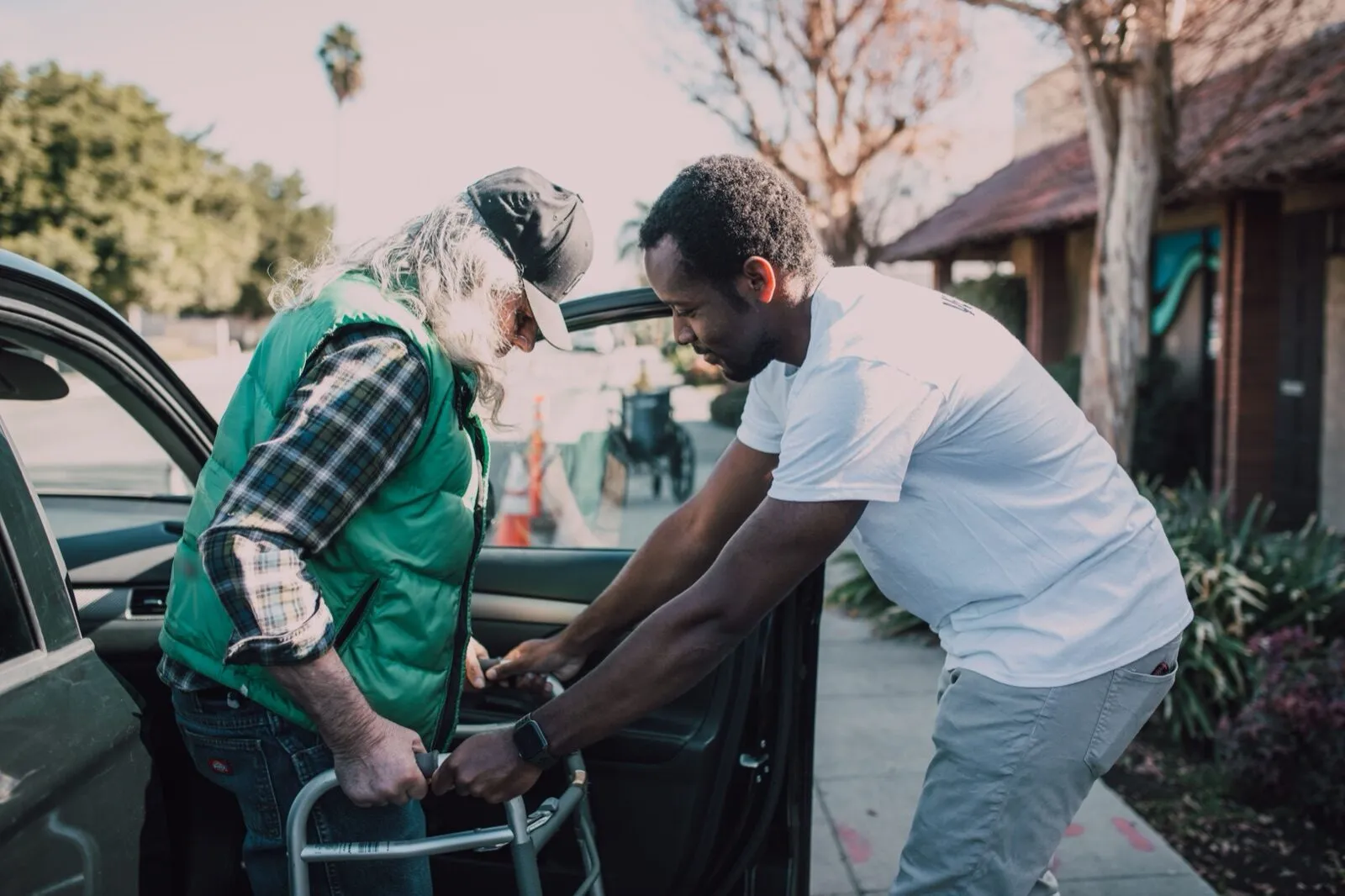
A qualified service provider, or QSP, is an individual or agency that North Dakota Health and Human Services (HHS) approves to serve people in its home and community-based services programs. One of the services a QSP can offer is non-medical transportation: rides to the grocery store, the pharmacy, the bank, and other errands that help an older adult or an adult with a physical disability keep living at home. For a van company, it is errand work that can sit beside NEMT.
NEMT is a different program. ND Medicaid pays enrolled NEMT companies directly for rides to medical care, and it has paused new NEMT agency enrollments statewide since June 11, 2026, as the North Dakota guide explains. QSP enrollment runs through its own portal, its own handbook, and its own rates.
What QSP transportation covers
HHS defines two transportation services, and you can enroll for one or both:
- Non-Medical Transportation, Driver with Vehicle (NMT-D). You drive the client from home to essential community services and back. HHS lists the grocery store, pharmacy, bank, post office, laundromat, utility company, and Social Security office.
- Non-Medical Transportation, Escort (NMT-E). You help the client through the errand itself, such as grocery shopping inside the store, or help a client who rides public transit get on, ride, and get off.
Under HHS policy 525-05-30-40 (revised April 1, 2023), a client qualifies through one of four programs: the Medicaid Waiver for Home and Community Based Services, the Technology Dependent Waiver, Service Payments for the Elderly and Disabled (SPED), or Expanded SPED. The HCBS case manager decides whether the client needs the service. The client must be unable to provide their own transportation, or need help with the task the ride is for. Clients on the Technology Dependent Waiver, and clients who receive Transitional Living, can get the driver service but not the escort.
The limits matter as much as the trips:
- No medical trips. QSP rides cannot go to or from a doctor, dentist, hospital, physical therapy, or any other health care provider. Those are NEMT.
- No work, school, or recreation, unless the ride is part of the client’s Companionship or Transitional Living service.
- The client must take part. If the client cannot ride or take part in the errand, HHS says the task may be covered under Homemaker instead.
- Another person’s vehicle needs permission. If you use the client’s accessible van or anyone else’s vehicle, the owner must give written permission and proof of insurance.
For how waiver rides differ from NEMT in every state, see waiver transportation providers and NEMT vs NMT.
Agency or individual QSP
HHS enrolls QSPs two ways. An individual QSP is a self-employed person who delivers the service personally, with a Type 1 NPI. An agency QSP enrolls as a business, bills HHS for authorized services, and adds its employees to its enrollment. A van company with hired drivers enrolls as an agency. If you serve only riders who pay you themselves, the handbook says you do not need QSP enrollment at all.
The two paths carry different paperwork:
- NPI. An agency needs a Type 2 organizational NPI, and the January 2026 agency handbook says to apply with taxonomy 253Z00000X (In Home Supportive Care). A former individual QSP cannot reuse a personal NPI for the agency. See how to get an NPI number.
- Competency renewals. Under policy 525-05-45-10 (revised July 1, 2026), an agency employee’s competency form lasts 60 months and an individual QSP’s lasts 30 months.
- Escort pay. Agencies earn more per escort unit than individuals, as the rate table below shows.
- Quality program. Agencies must run a quality improvement program. Individuals do not.
HHS treats every QSP as an independent contractor, not a state employee, and withholds no taxes from QSP payments.
Check the moratorium before you apply
Effective June 11, 2026, ND Medicaid placed a temporary enrollment moratorium on new QSP agencies in Burleigh and Cass counties, the counties around Bismarck and Fargo. The same notice froze new developmental disability agencies in those two counties and new NEMT agencies statewide. Applications in final approval on June 11 continued to approval, and the rest were denied.
The notice says the pause lasts six months and can be extended six months at a time, as 42 CFR 455.470 allows, so unless it is extended, the first period ends around December 11, 2026. As of October 6, 2026, the Medicaid Provider Updates page showed no extension or change. The state’s revalidation strategy proposed an exception for new providers needed in underserved areas, but the June 11 notice lists none.
What the pause leaves open:
- QSP agencies in the other counties. The notice names only Burleigh and Cass. It does not say whether an agency based elsewhere may list those two counties as a service area, so ask QSP Enrollment at QSPinfo@nd.gov before you count on it.
- Agencies already enrolled, which keep working and can add services through the portal.
- Individual QSPs. The notice names agencies only, and the revalidation strategy says the QSP moratorium is limited to agency-based QSPs.
- The 1915(i) program, covered at the end of this page, which is not on the notice.
How to apply in the QSP Enrollment Portal
All applications go through the QSP Enrollment Portal, reached from the HHS QSP page and signed in with an ND Login account. The QSP Hub at 701-777-3432 helps with the application by phone, email, or video. These steps follow the January 2026 agency handbook.
- Register your business with the Secretary of State, and get workers’ compensation coverage from WSI and unemployment insurance coverage from Job Service North Dakota. You upload proof of all three.
- Get a Type 2 NPI with taxonomy 253Z00000X.
- Pick a name that passes. Agency names may not include “home health agency,” “home health care,” “home health services,” “group home,” or “nurse.”
- Create a portal account with an email only your business uses, then choose your services and the counties you will serve. Choose counties where you have drivers or will drive, because the Provider Navigators send referrals by community and county.
- Upload the agency documents: an organizational chart with staff names (board members count as managing employees), government ID for owners and managing employees, job descriptions, direct deposit proof, and a private pay fee schedule if your rates differ from the state’s.
- Finish two trainings. The employee who trains your staff completes the Fraud, Waste and Abuse training and the Onboarding Orientation training, and you upload the certificates plus a roster of direct service staff.
- Add every driver in the portal. The portal screens each one against the ND courts, sex offender registries, the federal SAM and OIG exclusion lists, and the ND exclusion list, and tells you who is approved.
- Wait for approval and a service authorization. Enrollment dates are never retroactive, and you cannot be paid for any ride before the start date on the client’s authorization.
Driver standards
Each NMT driver must meet the standards in Charts A to D of the provider handbook:
- Competency. Each driver needs an SFN 749 with lines 5, 6, and 12 to 15 completed: hand washing, handling body fluids, toileting, incontinence care, transfers, and walking assistance. A physician, PA, nurse practitioner, RN, LPN, physical or occupational therapist, or chiropractor must sign it, and never a CNA. A current ND CNA, LPN, or RN credential counts instead.
- License. A current driver’s license in good standing from the state where the driver lives, copied into the personnel file and provided at enrollment and revalidation. A driver who has lived in North Dakota longer than the state allows on an out-of-state license needs an ND license.
- Vehicle attestation, kept on file. A driver who uses a personal vehicle signs and dates a statement that its brakes, lights, tires, and seat belts work and that the State is not liable for damages. The file also shows continuous insurance, or your agency’s coverage if the driver uses a company van.
- Registration and insurance. Keep both current for every vehicle that carries clients. You do not send proof with the application, but HHS can ask for it.
Policies you keep on file
You write these before you enroll and show them only if HHS asks: a compliance program, a fraud, waste, and abuse reporting process, and a quality improvement program. Under HHS policy 525-05-45-60 (August 1, 2024), non-medical transportation is one of the services that needs the quality program, which meets five standards: policies that prevent and report harm, staff who know how to spot and report abuse, clients who know how to report it, open communication with case managers, and records of each service. Among the required policies are critical incident reporting, employee screening, supervision, and coverage when a driver is out. See NEMT policies and procedures.
What QSP rides pay
HHS sets QSP rates on one sheet. These are the transportation codes effective July 1, 2026, from the sheet revised July 23, 2026. One unit of T2001 is 15 minutes, and one unit of T2003 or T2004 is a one-way ride.
| Code | What you bill | Agency | Individual |
|---|---|---|---|
| T2001 | Driving the client, per 15 minutes | $9.67 | $9.67 |
| T2001-UC | Escort, per 15 minutes | $9.28 | $6.76 |
| T2003 | One-way trip in your vehicle | Per trip | Per trip |
| T2004 | One-way trip by bus, taxi, or other carrier | Per trip | Not offered |
The sheet sets no dollar amount for the two per-trip codes, so confirm what the client’s authorization allows before you accept a trip billed that way. See T2003 and T2001.
Drive time counts only while the client is in the vehicle, both ways. The billing code guide says to bill T2001 only for time spent driving the client, and both HHS policy 525-05-38 and the agency handbook say QSPs are not paid for the time they drive to or from a client’s home, so the trip out to the pickup and back to your base after the last drop-off is unpaid. Escort time and drive time never overlap: the escort clock starts when the vehicle reaches the destination and stops when the client gets back in to go home.
Here is an example with made-up times: an agency drives a client 30 minutes each way to the grocery store and helps her shop for 60 minutes. That is 4 units of T2001 ($38.68) plus 4 units of T2001-UC ($37.12), or $75.80.
Four more rules shape the money:
- No rural add-on. The rural differential for QSPs who travel 21 miles or more round trip does not cover transportation (policy 525-05-38, revised February 1, 2025).
- Monthly caps. As of July 1, 2026, all SPED and Expanded SPED services together are capped at $4,873 per client per month, unless the client is in adult foster care. Waiver services are capped at the highest monthly nursing facility rate. Rides share those caps with the client’s other services.
- Client share. Some clients owe part of the cost. HHS subtracts it from your payment, and you collect it from the client.
- Your private rate is the ceiling. You cannot charge HHS more than your private pay clients. You may also choose a rate below the state’s.
Getting clients and authorizations
North Dakota law (N.D.C.C. 50-06.2) lets each client choose among available QSPs, and the case manager must tell them who serves their area. Your agency name and services may go on a public list of QSPs that clients use to choose, and you can ask to stay off it. Clients who want help choosing are sent to HHS’s Provider Navigators, who email the QSPs enrolled for those services in the client’s community.
- Answer within 24 hours. If no one answers in 24 hours, the Navigators email the next group of QSPs, including ones in the county willing to drive.
- Return the SFN 1702 acknowledgment in full within 24 hours of receiving it, or the next provider is chosen.
- Meet the client before you give final confirmation.
- Start within 10 days of accepting, or by the date everyone agreed, or the referral is rescinded (policy 525-05-45-20).
Where many agencies serve a town, the Navigators rotate them. The January 2026 handbook gives an example: Fargo had 80 agency QSPs on August 1, 2024, so referrals went to 10 at a time. Clients who already know whom they want skip the Navigators, so introduce your company to local case managers too.
The service authorization comes from the case manager, sent electronically through the state’s EVV system. It lists the tasks you may do, the date services can start, and the most units you can bill. You must also tell the case manager if you are approved for a service you are not enrolled for.
EVV, records, and claims
Both NMT services are subject to electronic visit verification, which North Dakota has required since January 1, 2021. Each driver checks in and out on a phone, tablet, laptop, or a device HHS issues. The state’s EVV and billing system is free, and agencies use it to acknowledge authorizations and file critical incident reports even if they choose a paid EVV system for visits. Only one EVV system may be used at a time. For how EVV works elsewhere, see EVV for NEMT.
Keep a record for every service for 7 years, even after you stop serving the client. Each record shows the client’s name and ID, your name and ID, the full date, the location, start and end times with a.m. and p.m., the units, and the tasks, named as they appear on the authorization. Records cannot be copied with dates changed. ND Medicaid must receive each claim within 180 days of the date of service, and it no longer accepts paper claims.
Revalidation and changes coming in 2027
Your enrollment lasts up to 60 months. HHS emails a revalidation notice 90 days before it expires and suspends payments if a complete revalidation is not in by then. A QSP that bills nothing for 12 months may be closed.
ND Medicaid’s two-year revalidation strategy, with off-cycle revalidation set to start June 5, 2026, singles out QSP, NEMT, and 1915(i) providers for closer oversight. It targets 254 QSP agencies and 1,221 individual QSPs, and it plans these changes:
- Early revalidation of every QSP agency and individual from January 1, 2027, expected to finish by June 1, 2028.
- Employee enrollment. Starting January 1, 2027, each agency employee who delivers QSP services would get an NPI, enroll as an individual provider, and affiliate with the agency, once an administrative code change is final.
- A three-year revalidation cycle for QSP, NEMT, and 1915(i) providers after June 2028.
In the meantime, report ownership, managing employee, and controlling interest changes in the portal within 30 days, and email QSPinfo@nd.gov within five business days of learning that an owner or employee has a new conviction. See Medicaid revalidation.
The 1915(i) program is a separate enrollment
North Dakota also pays non-medical rides under its 1915(i) behavioral health program. That service bills T2001 in 15-minute units, up to 8 hours a day, with no service authorization, and claims for dates of service on or after January 1, 2026 go through the state’s online billing module (manual updated April 2026). You enroll for it with ND Medicaid Provider Enrollment as a group, then affiliate each driver, not through the QSP portal. The waiver transportation guide covers its rules.
Frequently asked questions
Can a van company in Fargo or Bismarck become a QSP agency right now?
Not as a new agency, for now. Effective June 11, 2026, ND Medicaid placed a moratorium on new QSP agency enrollments in Burleigh and Cass counties. It lasts six months and can be extended in six-month periods, and applications not at final approval on June 11 were denied. Agencies already enrolled keep working. As of October 6, 2026, HHS had posted no extension, so check its Provider Updates page before you apply.
Can a QSP drive a client to a doctor or dialysis appointment?
No. HHS policy says QSP non-medical transportation cannot be used for trips to or from a doctor, dentist, hospital, physical therapy, or any other health care provider. Those rides are NEMT, a separate Medicaid service with its own enrollment. QSP rides also cannot go to work, school, or recreation unless the client gets them as part of Companionship or Transitional Living.
Do I need an NPI to enroll as a QSP agency?
Yes. An agency QSP needs a Type 2 organizational NPI, and the January 2026 handbook says to apply with taxonomy 253Z00000X, In Home Supportive Care. If you were enrolled as an individual QSP before, you cannot reuse that individual NPI for the agency. The QSP enrollment date cannot be earlier than the date your NPI was issued.
Does the QSP rural differential rate apply to transportation?
No. The rural differential pays more to QSPs who travel at least 21 miles round trip to serve rural clients, but HHS policy limits it to respite, homemaker, personal care, nurse education, extended personal care, chore labor, supervision, companionship, transitional living, waiver personal care, and community transition. Non-medical transportation is not on that list, and the July 1, 2026 rate sheet shows no rural rate for it.
Do QSP transportation rides need EVV?
Yes. The January 2026 agency handbook lists both Non-Medical Transportation Driver and Escort among the services subject to electronic visit verification. Staff check in and out on a phone, tablet, laptop, or a device issued by HHS. The state system is free, and you may use a different EVV system at your own cost if it sends the required data.
How long does QSP enrollment last?
Up to 60 months from approval, under HHS policy revised July 1, 2026. HHS emails agencies 90 days before the expiration date, and payments are suspended if a complete revalidation is not in by that date. ND Medicaid's revalidation strategy plans an early revalidation of every QSP starting January 1, 2027, and a move to a three-year cycle after June 2028.
Official resources
- ND HHS: QSP page (enrollment portal, handbooks, rates, and the QSP Hub)
- ND HHS: QSP Agency Handbook
- ND HHS: QSP rate sheet
- ND HHS: Explanation of QSP billing codes
- ND HHS: Non-Medical Transportation policy (HCBS manual 525-05-30-40)
- ND HHS: Provider enrollment moratoria notice
- ND Medicaid: Provider Updates (moratorium status)