Drivers and vehicles
Maryland PSC For-Hire Driver's License for NEMT Drivers: Who Needs One and How to Apply Online

Overview
In Maryland, anyone driving a sedan or van for a company with Public Service Commission carrier authority needs a PSC passenger-for-hire driver's license. Since April 1, 2026, drivers apply only online. The PSC wants six straight months of Maryland driving or a year anywhere, full driving records, your company's approval, and State and FBI fingerprints, about $56 at CJIS. Some county-only Medicaid work can be exempt.
- Every driver of a PSC-authorized sedan or van needs a PSC for-hire license, owner-drivers included.
- Since April 1, 2026, the PSC takes driver applications only through its online portal.
- State and FBI fingerprints at CJIS cost about $56 in person from October 1, 2026, and the receipt goes in the application.
- Repeat offenses carry look-backs of up to 15 years, but each rule lets the PSC weigh the record.
- A driver on county-only Medicaid trips may be exempt, but any other paid driving ends the exemption for that driver.
Which Maryland NEMT drivers need a PSC for-hire license
Title 10 of Maryland’s Public Utilities Article (PUA) covers every motor vehicle that carries people for pay, with two exceptions: vehicles designed for more than 15 people, and some transportation provided solely for a government unit or a nonprofit (PUA 10-102). Inside that scope, PUA 10-103 says no one may drive a vehicle for hire under a Public Service Commission (PSC) permit without a PSC for-hire driver’s license. The PSC’s Transportation Division describes the license as covering drivers of passenger-for-hire vehicles that carry 15 or fewer passengers.
For a NEMT company, that sorts your drivers into four groups:
- Drivers of your PSC-authorized sedans and vans. Each one needs a passenger-for-hire driver’s license before the first trip, and that includes you when you drive. The statute defines sedan service as for-hire driving in a vehicle designed for 15 or fewer people, driver included (PUA 10-101).
- Drivers of vehicles designed for 16 or more people. These vehicles fall outside Title 10. Their drivers need a commercial driver’s license instead, as do NEMT drivers need a CDL explains.
- Taxicab drivers. The PSC issues a separate taxicab driver’s license, on the same application, for taxicabs in Baltimore City, Charles County, Cumberland, and Hagerstown. A county or city elsewhere may license its own taxicab drivers if it runs criminal and driving record checks (PUA 10-103(b)).
- Drivers on some government contracts. A narrow exception can reach companies that drive only for a county or State program. It has its own section below.
The license is for the driver. Your company first needs PSC carrier authority, which the Maryland state guide walks through, and the driver application names that authority. For trips with both ends inside the WMATC district, which includes Montgomery and Prince George’s counties, you also need a WMATC certificate. Montgomery County’s Medicaid wheelchair van, stretcher, and ambulance programs ask for both your WMATC and your PSC certification, so plan on PSC licenses for drivers there too (see Montgomery County).
What the PSC asks of each driver
The checklist in the PSC’s online application, as its June 2026 training video shows it, and its application packet revised in October 2024 ask for:
- Driving experience. At least six months of consecutive driving in Maryland, or at least one year of consecutive driving in any state.
- A full driving record. A complete, full-history record issued within the last 30 days by the state that licenses the driver, plus one from every state where the driver held a license in the past 10 years. A 36-month record is not accepted. A Virginia record is the personal driving record. The address on the application must match the record, or the driver attaches an MVA address correction card dated on or after the record.
- Identity and work status. Copies of the front and back of the driver’s license and the Social Security card. The Social Security number is required under Maryland’s child support law (Family Law Article 10-119.3). A driver who is not a U.S. citizen uploads an employment authorization card, and a naturalized citizen uploads a naturalization certificate or U.S. passport. The PSC may ask to see the originals.
- A recent full-face photo, as a jpeg, png, or heic file.
- A State and FBI fingerprint check through CJIS, covered in the next section.
- Every conviction, in any state, for life. The application asks about any criminal conviction, any alcohol or drug related traffic conviction, and any traffic conviction. On this form, convicted means any civil or criminal penalty was imposed, including a suspended jail sentence, probation, probation before judgment, a fine, restitution, community service, or required substance abuse treatment.
- Your company’s approval. The driver selects your company by name in the portal. If it does not come up, the driver has to contact you. The PSC’s portal training video (June 2026) shows the carrier approving an application before the PSC finishes its review.
Falsifying the application can bring denial, suspension, or revocation, so have every driver list old tickets and pleas too.
The screening standards behind a denial
COMAR 20.95.01.26 sets the offenses that can stop a license. The state guide lists the single-offense look-backs, such as 7 years for most felonies and 3 years for reckless driving. Several more parts of the rule catch drivers:
- What counts as a conviction. A guilty finding, a plea of guilty or no contest, a finding of not criminally responsible, and probation before judgment while the probation is still running or once it has been violated.
- Other places count. Offenses in other states, federal courts, the military, and tribal courts are treated like Maryland offenses.
- More three-year traffic offenses. Texting or handheld phone use that causes injury, failing to stop for police, street racing, driving on a withdrawn or revoked license, driving with a counterfeit or altered license, and a revocation for refusing a chemical test.
Repeat offenses reach back further. Each look-back runs from the date the application is submitted:
| Repeat pattern | Look-back |
|---|---|
| Two or more felonies that are not crimes of violence, from separate incidents | 10 years |
| Three or more violent misdemeanors from separate incidents | 7 years |
| Two or more impaired driving, leaving the scene, or fleeing police offenses | 15 years |
| Two or more major traffic offenses not involving alcohol or drugs | 5 years |
Every rule says the PSC may deny, not that it must. The PSC can weigh 14 factors, including the applicant’s age at the time, the circumstances, time since the conviction, character references, treatment and rehabilitation records, parole or probation records, work history, restitution, conduct since, and the driving record. It can also hold an application until an open charge is resolved. Under PUA 10-105, a denied applicant can request a hearing. The same section has the PSC deny a license, after an administrative review, when the applicant’s physical or mental condition or criminal record makes denial necessary for the public. For how other programs treat records, see can a felon be a NEMT driver.
Fingerprints at CJIS: where to go and what it costs
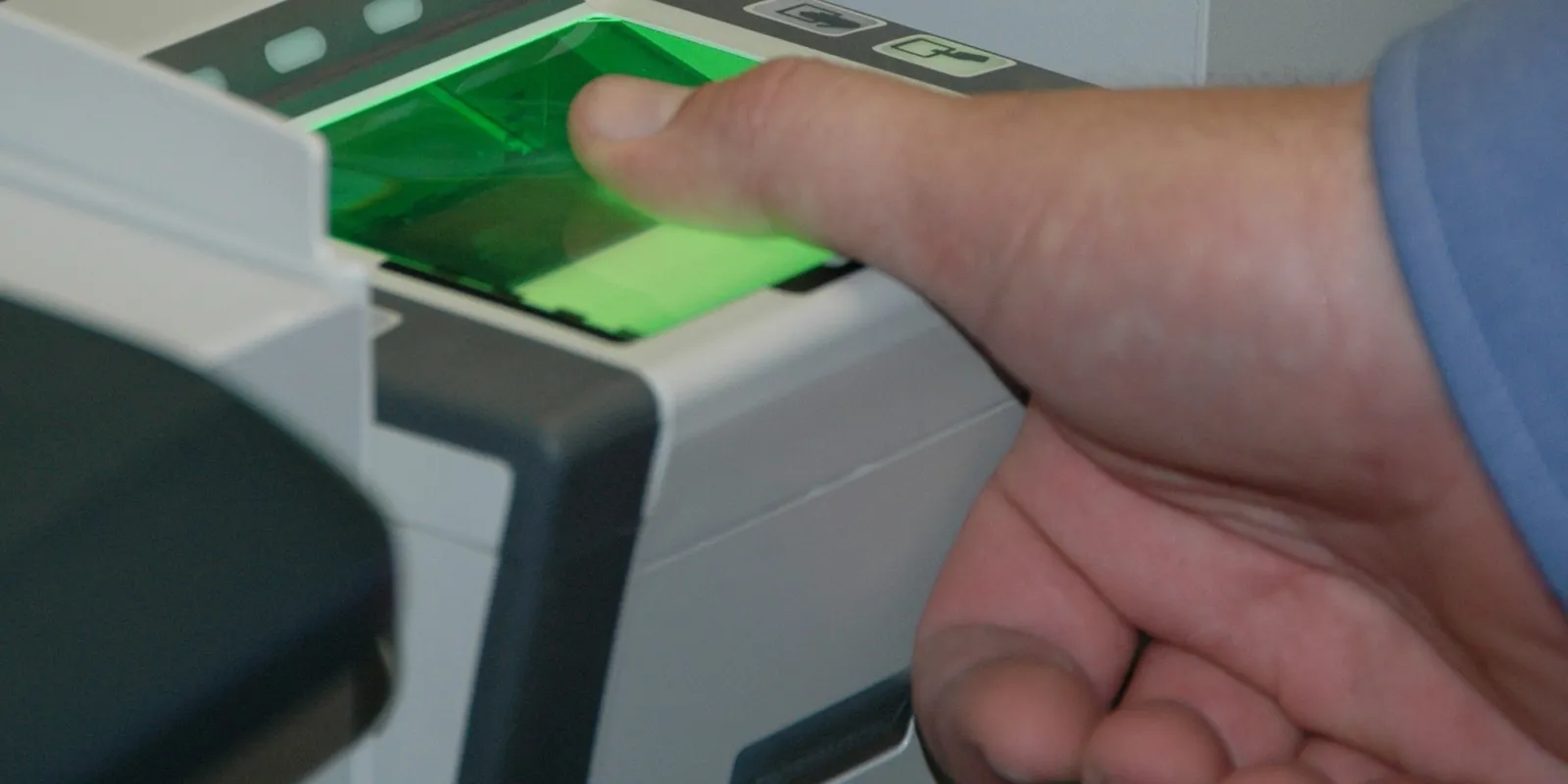
PUA 10-104 requires a State criminal history check through the Criminal Justice Information System (CJIS) Central Repository and lets the PSC add an FBI check, and the PSC requires both. Every applicant downloads the PSC’s LiveScan pre-registration form from the portal first. The driver fills in only the applicant section, because the PSC’s agency number is already printed on it.
Drivers can be fingerprinted at three kinds of places, as of October 2026:
- The CJIS storefront at 6776 Reisterstown Road, Suite 101, Baltimore, which takes walk-ins Monday to Friday, 8:30 a.m. to 5 p.m.
- CJIS offices in MVA buildings in Bel Air, Frederick, Glen Burnie, Salisbury, and Waldorf, by appointment at 410-764-4501 or 888-795-0011.
- An authorized private provider or a police or sheriff’s office that fingerprints, which you can find with the locator on the DPSCS fingerprinting page.
Bring a government-issued photo ID. CJIS’s fee page lists $53 for a State and FBI check taken in person, which is $33 for the checks plus its $20 service fee. It also says to add $3 to checks that include the FBI from October 1, 2026, when the FBI fee rose from $12 to $15, so plan on about $56. The PSC’s fingerprint form, updated in June 2026, still shows the older $51.25, so check the CJIS page before you go. Pay CJIS by credit or debit card, because it does not take cash or money orders. A private provider charges the check fees plus its own service fee.
Keep the receipt, because the driver uploads it with the application. CJIS sends its report to both the PSC and the driver. If a new arrest or conviction reaches CJIS later, it sends both of them a revised report (PUA 10-104), so the check keeps running for as long as the driver is licensed.
A driver who thinks the State record is wrong contacts the office of the Secretary of Public Safety and Correctional Services, which must hold a hearing within 20 workdays and decide within 5 workdays after it. FBI records are corrected under 28 CFR 16.30 to 16.34.
How to apply online, step by step
Since April 1, 2026, the PSC accepts passenger-for-hire and taxicab driver’s license applications only through its portal at mdpsctransportation.com. Give each new hire these steps:
- Confirm your carrier authority is active. The application ties the driver to your company by name and PSC carrier number.
- Order the driving records. Get the full-history record, dated within 30 days, from the state that licenses the driver (the MVA for a Maryland license), plus records from every other state the driver was licensed in during the last 10 years.
- Get fingerprinted with the PSC’s LiveScan form and keep the receipt.
- Register an account. The portal sends a one-time passcode to the driver’s email or phone at each login.
- Choose Apply for new license and select Passenger For-Hire.
- Work through the eight steps: checklist, applicant information, address and contact information, citizenship, license details, criminal background history, document uploads, and review and submit.
- Upload the documents: photo, fingerprint receipt, driving record, both sides of the license, Social Security card, and any work authorization, naturalization certificate, or passport.
- Sign and submit. The driver checks the boxes for the FBI privacy statement and the noncriminal justice applicant’s privacy rights, then types a name to sign.
- Watch the Applications List. If the status reads Need additional information, the driver uploads the missing documents on the same application.
The PSC says its applications take from 2 weeks to 60 days, depending on the application, as of October 2026. PUA 10-107 lets the PSC issue a temporary license for up to 30 days, and the portal has a menu for one. The PSC may also call a driver in for an interview at any time.
For help with the portal, the PSC’s June 2026 training video lists 410-767-8128 or 800-492-0474 and support@mdpsctransportation.com. The Transportation Division’s general line in its notice of February 20, 2026 is 410-767-8593. Under that notice, walk-in hours at 6 St. Paul Street, 18th floor, Baltimore, are 9 a.m. to 11:45 a.m. and 1 p.m. to 3:45 p.m., Monday through Thursday, and the office is closed to the public on Fridays. The PSC encourages appointments.
After the license: renewals and your duties as the owner
A for-hire driver’s license lasts from 1 to 3 years, as the PSC sets it (PUA 10-106), and the application form records a three-year license number. Drivers renew through the same portal, which also handles address changes and badge replacements. Track each expiration date, because a lapsed license takes that driver off your schedule.
Every driver signs these terms on the application, so hold your drivers to them:
- Carry the license whenever driving for hire, and never alter its entries (PUA 10-108).
- Report any change in the application’s information to the PSC within 72 hours.
- Understand what can end it. A suspended or revoked MVA license, a new criminal conviction, or expired work authorization can bring an immediate suspension or revocation of the PSC license.
The owner carries the risk too. COMAR 20.95.01.12 makes the permit holder ensure that only a properly licensed driver operates its vehicles. Under COMAR 20.95.01.06, driving without a valid passenger-for-hire license is a civil penalty violation, and an owner who neglectfully or knowingly allows it can be held responsible as if the owner were driving. For a common carrier, PUA 13-202 caps a safety penalty at $500 for each violation or related series of violations found in a single safety inspection.
Before a new driver’s first trip, look the driver up in the PSC’s Driver Search, which shows the badge number, carrier, and license expiration date. Keep a copy of the license, the fingerprint receipt, and the driving records in the driver’s file with the driver file checklist.
When a county Medicaid contract changes the rules
Maryland has no Medicaid broker. County health departments, and Montgomery County’s Department of Transportation, buy rides by contract, and two parts of the Public Utilities Article can apply to that work.
The government and nonprofit exception (PUA 10-102)
Title 10 does not apply to transportation provided solely by or on behalf of a federal, State, or local government unit, or a 501(c)(3) or (4) nonprofit, that requires a criminal history check and a driving record check for its drivers. It covers clients of listed services, including the Medical Assistance Program, kidney dialysis, aging services, developmental disabilities, and mental health. Three rules come with it:
- It is all or nothing for each driver. Under PUA 10-102(c), a driver who also drives anyone else for pay is back under Title 10 and needs the license. Private pay dialysis rides or facility contract trips end the exception for that driver.
- Nonprofits get a direct exemption. A nonprofit carrying clients of those services needs no motor carrier permit, and its drivers need no PSC license for that work (PUA 10-102(d)). Drivers employed by a government unit or nonprofit under the exception must apply to CJIS for a State criminal history check on or before their first day of work (PUA 10-102(e)).
- Vehicles follow a matching rule. PUA 9-201 waives the PSC permit for a vehicle a private company uses exclusively under a county, city, or State contract, and requires one for any vehicle it also uses for other work.
Whether a private company’s county Medicaid trips count as transportation on behalf of the county depends on the contract’s wording. Get the PSC’s answer in writing before a driver carries a rider without the license. Because outside paid trips end the exception, licensing every driver keeps your schedule open to private pay and facility work.
How county ride programs screen drivers
County contracts add their own checks on top of the PSC’s:
- The State’s vendor criteria. The Maryland Department of Health’s guide for the transportation grant program, with vendor monitoring criteria effective October 5, 2015, requires copies of every license that federal or State law requires, driving record and criminal background checks on file for everyone who serves riders, rechecked at least once a year, substance abuse screening, and driver training.
- Washington County. Its RFP issued April 13, 2026, requires a CJIS State and federal fingerprint check, at your expense, before anyone works on the contract. Anyone with a criminal record needs the contract monitor’s written approval first, and the monitor’s decision is final.
- Montgomery County. Its open solicitation 1171472 asks wheelchair van, stretcher, and ambulance companies for current PSC and WMATC certification and first aid and CPR certificates, plus each driver’s license number, expiration date, driving record, and drug test records.
A county’s annual recheck is separate from the PSC license, so put both dates in each driver’s file. For the federal exclusion lists and the other checks every program expects, see NEMT driver background checks and NEMT driver requirements.
Frequently asked questions
Do NEMT drivers in Maryland need a PSC for-hire driver's license?
Yes, when they drive for a company that carries passengers under PSC authority. PUA 10-103 bars anyone from driving a vehicle for hire under a PSC permit without a PSC for-hire driver's license. Vehicles designed for more than 15 people fall outside the law, and so does some transportation provided solely for a government unit or nonprofit that requires criminal and driving record checks for its drivers.
How much does a PSC for-hire driver's license cost?
The cost you can count on is the State and FBI fingerprint check. CJIS lists $53 for one taken in person, which includes its $20 service fee, and says to add $3 from October 1, 2026, when the FBI fee rose from $12 to $15, so plan on about $56. The PSC's fingerprint form, updated in June 2026, still shows the older $51.25. Private providers charge the check fees plus their own service fee.
How long does the PSC take to issue the license?
The PSC says its applications take from 2 weeks to 60 days, depending on the application, as of October 2026. Incomplete applications slow things down, so upload every document the first time. PUA 10-107 also lets the PSC issue a temporary license for up to 30 days.
Can a driver still mail a paper application?
No. Beginning April 1, 2026, the PSC stopped accepting paper applications for passenger-for-hire and taxicab driver's licenses. Drivers register an account at mdpsctransportation.com and apply there, uploading their documents and fingerprint receipt.
Can someone with a criminal record get a PSC for-hire license?
Sometimes. COMAR 20.95.01.26 says the PSC may deny a license for listed offenses within set look-back periods, and lets it weigh factors such as time since the conviction, rehabilitation records, and conduct since. A crime of violence or a sex offender registry listing can mean denial with no time limit. A denied applicant can request a hearing under PUA 10-105.
Does a Montgomery County NEMT driver need a PSC license if the company has WMATC authority?
Plan on it. Montgomery County's Medicaid wheelchair van, stretcher, and ambulance programs ask for current WMATC and Maryland PSC certification, so your vans run under PSC authority there too, and PUA 10-103 requires drivers under a PSC permit to hold the license. Confirm with the PSC Transportation Division at 410-767-8593.