Operations
Handicap Placard for a Business: Parking a NEMT Van, Loading Zones, and Tickets in 2027

Overview
Some states issue a handicap placard to a business that regularly drives people with disabilities. California gives an organization one placard per vehicle, Florida one permit per vehicle registered to it, and Texas limits institution placards to places where the rider lives. Any placard works only while a rider with a disability is on the trip. Everywhere else, use loading zones, keep access aisles clear, and set a ticket policy.
- California and Florida give an organization one disabled placard or permit per van. Texas gives institution placards only to facilities where the rider lives.
- A placard works only while a rider with a disability is on the trip, and never in a no-stopping zone or a striped access aisle.
- Hospitals and nursing homes built or altered under the 2010 ADA Standards must have an accessible passenger loading zone at an accessible entrance.
- A parking ticket reaches the registered owner first. Taking it out of a driver's pay can break federal and state wage law.
- MTM Health's Virginia program counts an unsafe loading spot as an infraction, so plan each stop before the ride.
Every NEMT driver knows the moment: the clinic door is 40 feet away, the curb is red, the accessible spaces are full, and a rider in a wheelchair is waiting. Where the van stops decides whether the ride is safe and whether a ticket lands on your desk. This page covers the three questions behind that moment: whether your company can hold its own placard, where the van may legally stop, and who pays when it gets a ticket.
Can a business get a handicap placard?
A disabled parking placard normally belongs to one person. Some states also issue them to organizations that drive people with disabilities. California, Florida, and Texas, the three largest states, show how much the rules differ.
| State | Who can get an organization placard | How to apply |
|---|---|---|
| California | An organization or agency that transports people with disabilities, one placard per vehicle used for it | Form REG 195, signed under penalty of perjury |
| Florida | An organization that gives regular rides to people with mobility impairments or legal blindness, one permit per vehicle registered to it | Form HSMV 83039, organization section |
| Texas | A facility where the rider lives, such as a nursing home, assisted living facility, or retirement community | Form VTR-214, with the administrator’s statement |
- California. Vehicle Code 22511.55(a)(4) lets organizations and agencies that transport people with disabilities apply for a placard for each vehicle they use for those rides. Vehicle Code 5007(a)(3) also offers disabled person plates for a vehicle used solely for that purpose. On REG 195 (revised November 2023), your authorized representative certifies under penalty of perjury that the vehicle is used to transport people with disabilities.
- Florida. Section 320.0848(1)(e) of the 2026 Florida Statutes allows permits for any organization that shows a real need because it gives regular rides to people with disabilities. The state’s organizations page says you get one permit per vehicle registered in the organization’s name, the permit shows your federal employer ID or Florida sales tax number, and it lasts up to four years and expires June 30. A false statement on HSMV 83039 is a first-degree misdemeanor, punishable by up to a year in jail, a $1,000 fine, or both.
- Texas. Section 681.0032 of the Transportation Code limits institution placards to a van or bus run by an institution, facility, or residential retirement community for the elderly where a person with a disability lives. A standalone NEMT company does not fit that rule. Under section 681.003, the owner of a vehicle regularly used to transport a person with a disability may apply on that person’s behalf, with that person’s medical statement. Form VTR-214 (revised September 2024) warns that false information is a third-degree felony.
A placard from one level of government may not work everywhere. New York State law lets a state facility, or an agency licensed by the state or a local government, that transports people with disabilities apply for the state permit (Vehicle and Traffic Law 1203-a). Inside New York City, though, that state hangtag works only in off-street accessible spaces. The city’s own placard, the one that works on its streets, goes to individuals, covers up to three listed vehicles, and cannot list commercial plates. Check with your state motor vehicle agency before you assume your vans qualify, and see ADA requirements for NEMT for the vehicle rules that come with wheelchair service.
When a placard can be used
An organization placard is not a parking pass for the van. In all three states, the privilege follows the rider.
- California. A driver may display a placard that was not issued to them only to transport a person with a disability (Vehicle Code 4461(c)), and a vehicle with disabled plates issued to someone else may not use a disabled space unless transporting one (4461(d)). A rider’s own placard may be used by someone else only while the rider is present or nearby and the trip is to transport them (4461(b)). Misuse brings a civil penalty of $250 to $1,000, or a misdemeanor with a fine in the same range and up to six months in county jail.
- Texas. A vehicle may park in a disabled space only while it is being used to transport a person with a disability and shows the plates or placard (section 681.006). A first offense for parking there without authorization is a misdemeanor with a fine of $500 to $750 (section 681.011).
- Florida. Stopping or parking in an accessible space requires a permit or plate and a vehicle transporting the person the permit was issued to (section 316.1955(1)). Meter fee exemptions follow the same rule (section 316.1964(1)).
A placard never opens a curb that is closed to everyone. California’s privilege does not apply where state law or an ordinance bans stopping, standing, or parking by all vehicles, or reserves a zone for special vehicle types (Vehicle Code 22511.5). Texas says a placard never permits parking where or when parking is prohibited (section 681.006(d)). In Florida, a driver with a permit can still be ticketed in bus loading zones, fire zones, access aisles, “No Parking” zones, emergency vehicle zones, and past posted time limits (section 316.1964(2)).
Florida adds one rule worth teaching every driver there. Anyone chauffeuring a person with a disability may stand temporarily in an accessible space to load or unload that person, without a permit, and cannot be penalized for it (section 316.1955(3)).
Where a NEMT van may stop to load a wheelchair rider
Passenger loading zones under the ADA
Section 209.3 of the ADA Standards requires at least one accessible passenger loading zone at an accessible entrance to every licensed medical care or long-term care facility where stays exceed 24 hours. That means hospitals and nursing homes. Where any building offers loading zones, section 209.2.1 requires an accessible one in every 100 linear feet of loading zone. New construction and alterations must follow the 2010 Standards when the permit application or the start of work falls on or after March 15, 2012, so older entrances may differ.
An accessible loading zone under section 503 has:
- A pull-up space at least 96 inches wide and 20 feet long.
- An access aisle at least 60 inches wide along the full length of the pull-up space, level with it, marked to discourage parking, and joined to an accessible route.
- Vertical clearance of at least 114 inches over the pull-up space, the aisle, and the drive in and out.
The access aisle is where a side lift or ramp comes down, and where the rider rolls off. Accessible parking spaces work the same way. A van space under section 502.2 is 132 inches wide with a 60-inch aisle, or 96 inches with a 96-inch aisle, and one of every six accessible spaces must be a van space (section 208.2.4). Van spaces and their routes need 98 inches of clearance (section 502.5), so measure your van’s height with any roof equipment before you send it into a hospital garage. The “van accessible” sign is informative, not restrictive, and enforcement is left to local law (advisory 502.6).
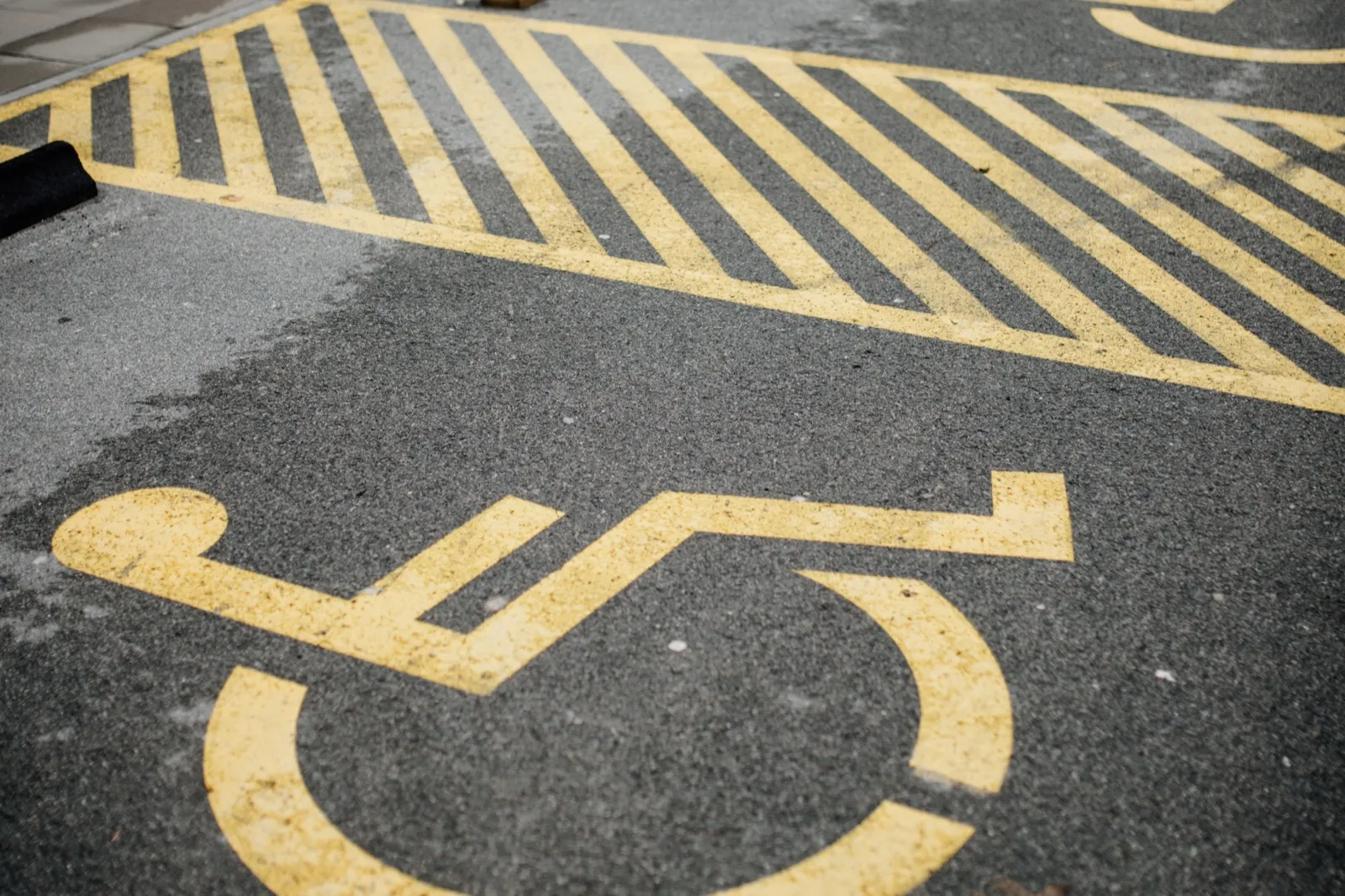
Never park in the striped aisle, even with a placard. California bars parking on the lines of a disabled space or in its crosshatched loading area (Vehicle Code 22507.8(c)). Texas makes blocking an access aisle or curb ramp an offense (section 681.011(c)). Florida punishes blocking an access aisle like parking in the space itself (section 316.1955(2)).
City curb rules: New York City as an example
City signs decide most curbside stops. New York City’s Department of Transportation draws the line by sign type.
| Sign | Drop off or pick up a rider | Wait at the curb |
|---|---|---|
| No Stopping | No | No |
| No Standing | Yes | No |
| No Parking | Yes | No |
The city also bans double parking of passenger vehicles at all times, whatever the purpose or length of the stop. Neighborhood Loading Zones allow car service pickups and drop-offs and active loading of personal vehicles, and new ones have used Loading Only signs since summer 2023. Hotel loading zones use No Standing signs. None of the three main signs allows waiting, so a driver who walks a rider inside should not count on the van staying legal at the curb. A rider’s city placard lets a listed vehicle park at No Parking signs, but it cannot list commercial plates, so it rarely covers a company van.
What brokers expect at the curb
MTM Health’s Virginia handbook (May 2026, approved August 10, 2026) has drivers stop where riders can reach the entrance without crossing streets whenever possible. The van must stay visible to the driver at all times, and riders are escorted inside before the driver leaves. Failing to park in a safe spot for loading counts as a 1-point infraction for each instance. Under its point system, 3 points suspend you from its trip marketplace until the points come off, 5 bring a 5-day suspension, 8 bring a 10-day suspension and the loss of recurring trips, and 10 remove you from its network. Points last a year.
That is why stops belong in dispatch, not left to the driver. Note the entrance, the loading zone, and any garage clearance on the rider profile the first time you drive someone. When a long walk to the door will make the driver late, follow the steps in what to do when a driver is running late.
Who pays a parking ticket
The ticket finds the van’s owner first. In California, the registered owner and the driver are jointly liable for parking penalties, and an owner who pays can recover the amount from the driver (Vehicle Code 40200(b)). In a Texas disabled parking case, the registered owner is presumed to be the person who left the vehicle (section 681.011(e)). Either way, the notice arrives at your company.
Getting the money back from a driver is where owners get into trouble.
- Federal wage law. Wages must be paid free and clear under 29 CFR 531.35. The Department of Labor’s Fact Sheet 16 (revised July 2009) says a deduction for a cost that mainly benefits the employer, such as damage to its property, may not push pay below the federal minimum wage, $7.25 an hour since July 24, 2009, or cut into overtime. That holds even when the employee was careless, and asking for cash instead of a deduction does not change it. The fact sheet does not name parking tickets, so the safe course is to treat a ticket from a company trip the same way.
- Minnesota. Section 181.79 bars deducting any claimed debt from wages unless the employee agrees in writing after the debt arises, stating the amount per pay period, or a court finds the employee liable. Agreements signed in advance are void, and an employer that breaks the rule owes twice the deduction.
- California. Labor Code 221 makes it unlawful to collect back any part of wages already paid, and section 224 allows deductions only when a law requires them or for certain items the employee authorizes in writing. Labor Code 2802 also makes the employer cover an employee’s losses from doing the job or following its directions, even unlawful ones, unless the employee believed them unlawful at the time. A ticket a driver gets while following dispatch’s instructions is generally yours to pay.
Parking fees are a separate matter from fines. Some payers pay garage fees and tolls on a trip, billed with A0170, and others do not.
Write a ticket policy before the first ticket
- Plan each stop at intake. Record the entrance, the loading zone, and any height limit on the rider’s profile.
- Teach your city’s curb rules. Show drivers which signs allow a passenger stop and which allow none.
- Tie the placard to the trip. The placard goes up only while a rider with a disability is on the trip, and never in an aisle.
- Log every ticket. Record the trip, the driver, the place, the reason, and the amount the day it arrives.
- Pay or contest each one by its deadline. Keep the trip record, the time stamps, and photos of the signs to support an appeal.
- Decide who pays, in writing. Put the rule in your driver handbook, and check your state’s wage deduction law before you collect a cent.
Your van’s markings matter at the curb too, because parking officers and facility staff read them. The NEMT vehicle signage guide covers what to put on the van and what to leave off.
Frequently asked questions
Can a NEMT company get a handicap placard for its vans?
In some states. California lets an organization that transports people with disabilities apply for one placard for each vehicle it uses for those rides, on form REG 195. Florida issues one permit per vehicle registered to an organization that gives regular rides to people with mobility impairments or legal blindness, on form HSMV 83039. Texas issues institution placards only for a van or bus run by a facility where the rider lives, such as a nursing home, assisted living facility, or retirement community.
Can my driver use the rider's own placard in the company van?
It depends on the state. California lets a placard holder allow another person to use it only while the holder is present or nearby and the trip is to transport them. New York City's placard for people with disabilities covers only the vehicles listed on it, up to three, and commercial plates cannot be listed. Ask the rider to bring their placard, and check your state's rule before your driver hangs it.
Can my driver park in an accessible space while going inside for the rider?
Only where the law allows it. Florida lets a driver who is chauffeuring a person with a disability stand temporarily in an accessible space to load or unload that person, without a permit. Otherwise the space needs a placard or plates and a rider with a disability on the trip. Never park or wait in the striped access aisle beside the space, which California, Texas, and Florida all bar.
Who pays a parking ticket, the company or the driver?
The ticket goes to the vehicle's registered owner first. In California the registered owner and the driver are jointly liable for parking penalties, and an owner who pays can recover the amount from the driver. Texas presumes the registered owner left the vehicle in a disabled parking case. Decide in writing who pays, and follow wage law before you collect anything from a driver.
Can I deduct a parking ticket from a driver's paycheck?
Carefully, if at all. Under federal wage law, a deduction for a cost that mainly benefits the employer may not push the week's pay below minimum wage or cut into overtime, and asking for cash instead does not change that. Minnesota bars any deduction for a claimed debt unless the employee agrees in writing after it arises, and California bars collecting back wages already paid.
Does a dialysis clinic have to have a passenger loading zone?
Not under the ADA rule that requires one. Section 209.3 of the 2010 ADA Standards requires an accessible passenger loading zone at licensed medical care and long-term care facilities where stays exceed 24 hours, such as hospitals and nursing homes. An outpatient clinic that offers loading zones must make at least one in every 100 feet of loading zone accessible, under section 209.2.1.
Official resources
- California DMV: Application for Disabled Person Placard or Plates (REG 195)
- Florida DHSMV: Disabled Person Parking Permits for Organizations
- Texas DMV: Disabled parking placards and plates
- NYC DOT: Parking Regulations
- U.S. Access Board: ADA Accessibility Standards
- U.S. Department of Labor: Fact Sheet 16, wage deductions